Showing posts with label Plant Anatomy. Show all posts

Sunday, October 19, 2025

Yes, These Are Flowers

A closeup view of the base of a violet plant, showing several whitish, bud-like flowers on white stalks.

The whitish, stalked, bud-like structures at the base of this common blue violet (Viola sororia) are flowers, and at about half an inch long, this is as big and showy as they get.

Unlike the blue-purple flowers that bloom in spring, these flowers start to appear in summer and last into fall. They have little or no pigment, reduced or no petals, and no nectar. They don't need these things because they don't need to lure insect pollinators. They never open, so they pollinate themselves.  

In botanical terms, these closed flowers are cleistogamous (kly-STOG-amus), meaning "closed marriage." In contrast, the showier flowers of spring are chasmogamous (kaz-MOG-amus), meaning "open marriage."

Each type of flower can benefit the plant. The chasmogamous ones are cross-pollinated by insects, potentially mixing genes from different parents as pollen is carried from plant to plant. The resulting seeds grow into offspring that have gene combinations different from their parents and from each other, potentially giving them new traits that improve their survival and reproduction. 

That's an advantage if their environment changes over space or time. In a population, more genetic variation among individuals increases the odds that at least a few of them will have the traits needed to grow in uneven or changing conditions. 

The downside is that chasmogamous flowers are expensive. The plants spend much of their stored energy making pigments for petals, sugars for nectar, and longer stalks to lift the flowers to leaf height or above, where they will attract pollinators. If something happens to the flowers -- if they're eaten by an herbivore or if pollinators don't visit, for example -- that energy is wasted. That also puts the next generation at risk. If there are no seeds, there are no offspring.

Two images, one showing a clump of violets with several purple flowers and another showing a closeup of a single flower.
The chasmogamous (open) flowers of common blue violet attract insect pollinators. The blue-purple pigments, darker nectar guides on the lower petal, and hairs on the lateral petals take much of the plant's stored energy to produce. 


Cleistogamous flowers provide a back-up, among other benefits. In terms of energy, they're much less expensive to make, and they don't rely on pollinators to make seeds. That's an advantage if the chasmogamous flowers are missing or aren't pollinated, because the plants have another way to produce seeds. It's a second chance.

Because they're self-pollinated, cleistogamous flowers produce seeds and offspring that are genetically identical to the parent and to each other. That's beneficial if environmental conditions are favorable and stable. If the parent is genetically well-adapted to the conditions, then the offspring will be, too, because those genes are preserved by self-pollination.

Self-pollination can also help get rid of versions of genes, called alleles (ah-LEELS), that reduce fitness, i.e., successful growth and reproduction. Cross-pollination can mask these harmful alleles by contributing healthier ones from other plants, thereby blunting any deleterious effects. Self-pollination, though, increases the odds that the effects of the alleles, now not partnered with more favorable ones, will show up in a plant's anatomy or physiology. That's bad for individuals that die or are unable to reproduce as a result, but the loss of those individuals can eliminate the responsible alleles from a population.  

Genetic uniformity can be a disadvantage, too, especially if conditions vary across a habitat or if they change over time.. A new environment may require adaptations the population doesn't have, because the plants are genetically identical. For example, if conditions are warmer and drier but the offspring come from a parent adapted to cooler, wetter conditions, they may not reproduce or even survive. 

Another potential disadvantage of cleistogamy is inbreeding depression, the loss of fitness that can result from maladaptive alleles that aren't "weeded out" by self-pollination, as described above. Also, although cleistogamous flowers usually produce more seeds than chasmogamous ones, the seeds tend to be dispersed closer to the parent plant, which can increase competition among siblings (1). 

A photo showing the three-parted capsule of a chasmogamous flower opened and emptied of seeds, and an opened cleistogamous flower capsule with many maturing seeds.
`

If you find cleistogamous flowers in violets or other plants, you'll be looking at something really old. Cleistogamy developed about 100 million years ago in some of the first flowering plants and has developed in many species since then. According to one estimate, worldwide there are at least 693 species of cleistogamous plants in 50 families (1). That was in 2007; more cleistogamous plants might have been discovered or confirmed since then. 

Although cleistogamy is present in a minority of plants, its long persistence among many species suggests that it has improved plant reproduction and survival. In at least 50 families, these plants converged independently on the same solution to the challenges of floral reproduction. That's profound, even amazing -- in a colorless, nectarless, inconspicuous kind of way.


Cited Reference

1) Theresa M. Culley and Matthew R. Klooster. The Cleistogamous BreedingSystem: A Review of its Frequency, Evolution and Ecology in Angiosperms. The Botanical Review 73 (1): 1-30. 2007. 


Additional References

Anne L. Sternberger and others. Environmental impact on the temporal production of chasmogamous and cleistogamous flowers in the mixed breeding system of Viola pubescens. PLoS One 15 (3). 2020. 

M.W. Austin, P.O. Cole, K.M. Olsen, and A.B. Smith. Climate change is associated with increased allocation to potential outcrossing in a common mixed mating species. Am J Bot.109(7): pp.1085-1096. 2022. 

Theresa M. Culley. Reproductive Biology and Delayed Selfing in Viola pubescens (Violaceae), an understory herb with chasmogamous and cleistogamous flowers.International Journal of Plant Sciences 163 (1): pp. 113-122. 2002. [Available to view with a free JSTOR account.]


Monday, February 3, 2025

Nature's Ancient Engineers

Two mushrooms with caps that are orange with irregular white patches. They are growing out of the soil.
Young mushrooms of fly agaric, Amanita muscaria, in a northern Minnesota mixed coniferous-deciduous forest.The caps of the mushrooms will flatten and expand up to 10 inches wide.

Chances are, you recognize this mushroom. Fly agaric has long been known for its colorful cap, its hallucinogenic effects, and its supposed ability to attract and kill flies. It has also found its way into popular literature and media; It’s the Alice in Wonderland mushroom, the place where Smurfs live, and the Super Mushroom in Super Mario Bros. games. Unfortunately for some, it’s also poisonous, even deadly (1, 2).

Less known but much more significant is what fly agaric does below ground. The mushroom is just the visible part, the body that produces spores for reproduction. Underneath it is an extensive network of thread-like strands called hyphae (HY-fee), together called the mycelium (my-SEE-lee-um). The hyphae are like hunter-gatherers; they run through the soil and absorb water and nutrients to support the rest of the fungus.

Fly agaric also needs organic (carbon-containing) molecules, such as sugars and amino acids, the building blocks of proteins. Many fungi obtain these by breaking down dead organic matter in the soil. Fly agaric, though, goes about it differently: It barters with living plants.

The one above likely does business with white pine (Pinus strobus), red pine (Pinus resinosa), paper birch (Betula papyrifera) or quaking aspen (Populus tremuloides) in the northern Minnesota forest where it grew (3). Beneath the surface, its mycelium wraps around the tips of the trees’ roots, forming a sheath. Some of the hyphae in the sheath grow into the root and form a net around some of the cells. That’s where the exchange occurs: The fungus gives water and nutrients to the plant, while the plant gives organic molecules to the fungus. 


A 3-paned illustration showing a microphotograph of a root sheathed by a fungus, a drawing of a root showing how the fungi surround the root and its cells, and a microphotograph showing Hartig nets around root cells.
Illustration of an ectomycorrhiza, which forms a sheath around root tips. Hyphae cross the epidermis and enter the root cortex. There they form a net, called a Hartig net, between the cells. The unit of measurement in the upper right scale is 100 microns. One hundred microns is the approximate width of a human hair. The photographs are colorized images produced by a scanning electron microscope, or SEM. Illustration by Atrebe10, licensed under Creative Commons Attribution-Share Alike 3.0 Unported license, via Wikimedia.

This symbiotic relationship is called a mycorrhiza (MY-co-RY-za), literally “fungus root.” The sheathing type, called an ectomycorrhiza, is relatively new, about 200 million years old give or take a few million years. An older type, roughly 400 million years old, doesn’t sheath a plant’s roots but instead grows inside the root cells themselves, where the exchange of nutrients, water and organic compounds occurs. This type is called an endomycorrhiza or arbuscular mycorrhiza, the latter named for the tree-like growth, called an arbuscule, the fungus forms inside the cells.

Development of mycorrhizae (plural, ending in -zee) was critical to the transition of plants from water to land hundreds of millions of years ago (4, 5 7). These early land plants had no roots or vascular (conducting) tissues. Those that eventually developed symbiotic associations with fungi had an advantage, because mycorrhizae could extend the plant's reach into the soil to obtain water and nutrients. Mycorrhizae were so beneficial that they developed independently many times over, involving different plants and fungi (6).

Given that far-reaching history, it’s no surprise that there are more types of mycorrhizae than the two described above. Ecto- and endomycorrhizae are the most common, but there are at least two more types (6). Whatever the type, in most cases both partners benefit and often are dependent on each other for survival. Without their association, neither partner would thrive. Their ecosystems wouldn’t, either.

That’s because approximately 80% of modern terrestrial plants are mycorrhizal, although the percentage of such plants in a community can vary (7). Prairies, deciduous forests, coniferous forests, and other terrestrial ecosystems are generally dominated by mycorrhizal plants. They are the foundation of these systems, supporting all the trophic (feeding) levels above them. A mycorrhizal white pine, for example, grows the cones that hold the seeds that feed a variety of birds and mammals, which in turn have their own roles in their communities.

Mycorrhizae are so important to ecosystems that restoring highly disturbed places, such as mines and abandoned agricultural fields, can be helped by adding mycorrhizal fungi to soils or seeds when restoration begins. Mycorrhizae have also been suggested as possible remedies for high carbon dioxide levels in our atmosphere, because they can help move carbon below ground. These practices will be the subjects of the next post.

References

1.      Two cases of severe Amanita muscaria poisoning including a fatality. Ethan M. Meisel, MD, and others. Wilderness and Environmental Medicine, Vol. 33, No. 4, 2022.

2.     Notes from the field: Acute intoxications from consumption of Amanita muscaria mushrooms — Minnesota, 2018. Joanne Taylor and others. MMWR Morb Mortal Wkly Rep 2019, Vol. 68: pp. 483–484, 2019.

3.     Fungus associates of ectotrophic mycorrhizae. James M. Trappe. Botanical Review, Vol. 28, No. 4: pp. 538-606, 1962. Available for reading with a free JSTOR account at https://www.jstor.org/stable/4353659.

4.     The origin and evolution of mycorrhizal symbioses: from palaeomycology to phylogenomics. Christine Strullu-Derrien and others. New Phytologist, Vol. 220, No. 4: pp.1012-1030, 2018.

5.      History of mycorrhizae. Jake Sun, Lindenwood University. The Confluence, Vol. 1, No. 2: Art. 2, 2022.

6.      Mycorrhizal Fungi. Society for the Protection of Underground Networks. Website accessed February 3, 2025.

7.      Coevolution of roots and mycorrhizas of land plants. Mark C. Brundrett. New Phytologist, Vol. 154, No. 2: pp. 275-304, 2002. 


Thursday, November 9, 2023

Moonseed Vine: A Poisonous Grapevine Look-Alike

Moonseed vines with twining stems and fading leaves.
Moonseed vine, Menispermum canadense, in early fall. Although most of its leaves have now fallen, it can still be identified -- and avoided, if foraging.

Moonseed vine (Menispermum canadense), also called Canada moonseed, is a twining vine of deciduous forests and riverbanks, thriving in moist or mesic soils and partial shade. Although the vines have now shed their leaves, moonseed vine can still be identified by other characteristics, and for foragers of wild foods, the distinctions could be lifesaving.

The danger comes from mistaking moonseed vine for riverbank grape (Vitis riparia). Both vines produce clusters of deep blue or purple, spherical fruits that can remain on the vines through winter. Unlike edible grapes, however, moonseed fruits are poisonous.

That’s because moonseed vine contains alkaloids, compounds many plants produce for defense against herbivores. Although alkaloids have been and are used medicinally, they can also be poisonous. Several sources report that eating moonseed vine, especially the fruits and seeds, can be fatal because of its alkaloids. The Minnesota Poison Control System includes moonseed on its list of toxic plants and advises calling Poison Control if any part of the plant is eaten.

Fortunately, poisoning can be avoided. There are reliable ways to tell the difference between moonseed and riverbank grape, even in fall and winter. Here’s what to look for.

Seeds
Mash fruits and crescent seeds of moonseed vine.

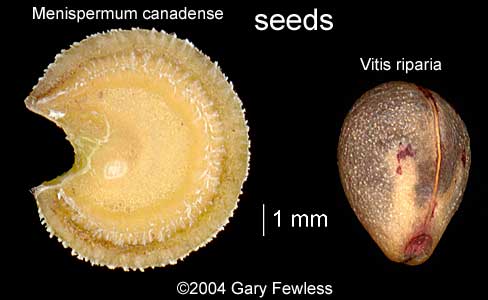
Moonseed fruits contain single, flat seeds that look like crescent moons. In contrast, riverbank grape seeds are egg-shaped, and there are usually several inside each fruit. This photo from the University of Wisconsin shows them side by side. 

Twining vs. grasping vines

Moonseed is a twining vine. It clambers over other vegetation or climbs upward by wrapping its stems around small trees or shrubs. Riverbank grape is a grasping vine. It uses tendrils, modified leaves, to clutch onto supports and hold the vines upright. 

A panel of two photos showing moonseed vines with twining stems and grapevine stems with coiled, grasping tendrils.
Twining stems of moonseed vine, left, and grasping stems of riverbank grape, right.

Stems and bark

The young stems of moonseed vine are brown or greenish brown and hairy, although as the stems age, they lose the hairs. Stems grow as large as 2 cm in diameter ( a little less than an inch) and have ridged or fluted bark. 

Younger stems of grapevine are brown or reddish brown and hairless. Mature stems grow up to 20 cm in diameter (about 8 inches) and have brown, shaggy bark.

Young moonseed stems, left, are brown or brownish green and hairy. Young stems of riverbank grape, center, are reddish brown and smooth. Mature stems of riverbank grape, right, are brown and shaggy. 

Leaf scars and buds

Leaf scars are marks on woody stems left by petioles when leaves are shed in fall. Inside them are small, often raised dots called bundle scars, created when strands of vascular cells (water- and food-conducting cells) are severed when leaves fall off the stem. Buds – next year’s protected growth – sit above the leaf scars.

The leaf scars of moonseed vine are typically 2-3 mm long and wide, oval to circular in outline, and concave. They are often notched or split at the top. Inside the leaf scar, the bundle scars are arranged in a faint, broken circle or oval. The bud is barely visible above the leaf scar; it appears to be embedded in the stem, protruding a millimeter or less above the surrounding tissue.

Leaf scar and bud of moonseed vine viewed from the front (left) and side (right). 

The leaf scars of riverbank grape are typically 2-4 mm long and wide and roughly triangular, semicircular, or U-shaped. The perimeter of the leaf scar may be ridged, but the leaf scar is not noticeably concave. To the side of the leaf scars are linear marks called stipule scars.(Stipules are thread-like or leafy structures at the bases of petioles in some plants.) Bundle scars are hard to see, but there are several. The bud is brown or reddish brown and 3-5 mm long. 

Leaf scar, bud and stipule scar of riverbank grape viewed from the front (left) and side (right).

Leaves, if still present

Both moonseed vine and riverbank grape have alternate, lobed leaves, but they have different margins (edges) and points of petiole attachment. These features can also be found on fallen leaves if they’re still intact.

The margins of moonseed leaves are smooth, although the lobes may have pointed tips. In addition, the petioles are attached inside the leaf blade, even if just barely, making a peltate or shield-shaped leaf blade. The leaves of riverbank grape are sharply and coarsely toothed, and the petiole is attached at the edge of the blade, at its base. 

Riverbank grape, left, has lobed, coarsely toothed leaves. Moonseed vine (right) also has
lobed leaves, but the margins are smooth, not toothed.

The petiole of riverbank grape, left, is attached at the edge of the blade. The petiole of
moonseed vine, right, is attached just inside the blade. 

Rhizomes and roots

Although aboveground characteristics are enough to positively identify moonseed and grapevine, belowground structures can also be helpful if it's possible -- and permissible -- to uncover or uproot them.

Moonseed vines have yellow rhizomes, underground stems that grow horizontally and produce roots and shoots along their length. Because of their color and traditional use to treat various ailments, Dakota Indians call it yellow medicine, the namesake of Yellow Medicine River and Yellow Medicine County in southwest Minnesota. The homeland of the Dakota is Pezihutazizi Kapi, “the place where we dig for yellow medicine.”

No source for this article describes grapevine as having rhizomes, but its woody, brown stems can become buried and grow roots at their nodes. These rhizome-like stems look nothing like the slender, yellow rhizomes of moonseed vine, however. 

The rhizomes of moonseed vine, left, are yellow. The roots and rhizome-like stems of riverbank grape, right, are brown.

Moonseed vine is found in much of Minnesota but is more abundant in the southern part of the state. Its broader range generally covers the eastern half of the US. The vine flowers in late spring and early summer. For more information, see the webpages from Minnesota Wildflowers and The Friends of the Wildflower Garden, Inc. Both are linked below.

Range maps of moonseed vine, from the USDA Plants Database.

Riverbank grape is also found in most of Minnesota except for several counties in the far north and northeast. More broadly, its range extends from the Mid-Atlantic states into New England and west through the Dakotas.

References

Wednesday, October 11, 2023

Flinging Spores and Fern ID

Sori on the back of a lady fern frond. Dozens of brown sporangia emerge from beneath the edge of a nearly translucent indusium.

The back of this lady fern frond (Athyrium filix-femina) is covered with sori, clusters of spore-forming bodies called sporangia. Each sorus holds dozens of them, all covered by a protective flap of tissue called an indusium. When a sporangium matures and dries, a line of cells over the top of the sporangium contracts, causing it to fling open and catapult its spores. You can watch it happen here in a sorus of an unidentified fern.

A spore print made by a lady fern frond. The spores are so small they look like dust. 

Unlike seeds, spores don’t contain embryonic plants. They’re little more than tiny packages of DNA that give rise to the next generation of ferns. They do this by first growing a small, heart-shaped prothallus, a body that produces egg and sperm cells. The flagellated sperm cells swim through a film of water to fertilize the egg cells, which then grow into the ferns we recognize. Because water is needed for this kind of reproduction, many ferns rely on damp or humid habitats.

A closeup of the back of a lady fern frond with a labeled sorus, sporangia and indusium.
Lady fern is identified in part by the shape of its sori. They are usually curved or
horseshoe-shaped. They appear in late summer and early fall.

A cluster of brown fertile fronds of ostrich fern. Their shapes resemble ostrich feathers.
Fertile fronds of ostrich fern.
Not all ferns have sori that look like those of lady fern. Some are located along the edges of the frond, some have indusia of different shapes or sizes, and some have no indusia at all. Other ferns, such as ostrich fern (Matteuccia struthiopteris) and sensitive fern (Onoclea sensibilis), produce spores on fronds specialized for that purpose – in other words, the whole frond is devoted to forming spores. For all these variations, timing is important. Sori and reproductive fronds (aka fertile fronds) may appear only at certain times of the year, and the appearance of sporangia and sori can vary depending on how old they are. 


Both reproductive and vegetative characteristics are helpful to identify a fern. Here are some resources to learn more about fern anatomy, biology and identification.

  • Ferns. U.S. Forest Service. This site may take a few tries to load.
  • Dichotomous Key to Ferns of Wisconsin, by Tim Gerber, UW-La Crosse.
  • Key to Fern Traits, by Areca Treon. This is a key to ferns in Cedar Creek Ecosystem Science Reserve near Bethel, MN.
  • Ferns of Minnesota, by Rolla Tryon. Illustrated by Wilma Monserud. University of Minnesota Press, 1980. ISBN 0-8166-0932-2.
  • Ferns and Lycophytes of Minnesota: The Complete Guide to Species Identification, by Welby R. Smith (author) and Richard Haug (photographer). University of Minnesota Press, 2023. ISBN 1517914663.

 For more information about lady fern, try these sites:

Saturday, August 19, 2023

Once Upon a Milkweed

A black and gray sweat bee walking on top of a group of pink swamp milkweed flowers.
A sweat bee (genus Lassioglossum) on swamp milkweed (Asclepias incarnata) is in a precarious position. 


Milkweeds are familiar to many as essential for Monarch butterflies, but there’s much more to their story. A close look at their flowers shows an intricate structure with a tricky way to snag insects – literally.

The flowers of swamp milkweed (Asclepias incarnata), like many other milkweeds, are composed of five reflexed petals, five upright hoods, and five narrow horns around a gynostegium, a central column of fused stamens and pistils. The bases of the hoods hold nectar, and between them are narrow slits bordered by two “guide rails.” Each slit leads to a chamber that contains the reproductive parts of the flower, including the stigma, the part that receives pollen. For that reason, it’s called the stigmatic chamber.

A group of swamp milkweed flowers with the petals, horns, hoods, gynostegium and stigmatic slits labeled.

What’s missing from the flowers are anthers shedding dust-like pollen grains. Unlike typical flowers, milkweeds don’t offer individual grains for insects to carry away. Instead, their pollen is packed into waxy sacs called pollinia. Each chamber holds two pollinia connected by a pair of arms and a central gland or corpusculum, Latin for “little body.” The whole structure, called a pollinarium, looks like a small pair of winged maple seeds.

Pollinia are rare. Only orchids also make them. The advantage of packing pollen grains together is that they can be carried as one unit to deliver hundreds of grains to the stigma of another flower. That improves the odds that every ovule in an ovary will be fertilized and develop into a seed. 

[Sidebar: In seed plants, ovules contain egg nuclei and develop into seeds. One or more ovules reside in an ovary, which sits at the base of a pistil, the “female” reproductive part. Above the ovary is a neck-like style and the stigma, the surface that receives pollen. Ovary walls develop into fruits.]

The challenge for milkweeds is to somehow get the pollinia out of the chamber and onto another flower. To accomplish this, milkweeds rely on bees, wasps, flies and butterflies as carriers. The insects visit the flowers to get nectar, and in the process, take the pollinia. And that’s where it gets tricky.

As an insect walks across the waxy surface of a milkweed flower, a leg or other body part can accidentally slip into one of the slits between the hoods. The corpusculum then catches its leg, forcing the insect to pull hard to get it out. Sometimes the insect doesn’t succeed, and it either leaves behind a leg or dies trying to get it loose. But if the insect can manage, it extracts its leg with the pollinarium attached. Then it’s off to another flower and perhaps another slip into a chamber, where the pollinia are deposited and the pollen can reach the stigma.

A bristly tarsus of a digger bee to which a dangling yellow pollinium is attached.
Pollinarium with dangling yellow pollinia on the tarsus (lowest leg segment) of a digger bee. 
Photo by Allan Smith-Pardo, Bees of the United States, USDA APHIS PPQ, Bugwood.org.

That’s a lot of effort, for both the insect and the plant. The reward for the insect, if it isn’t snagged forever in a milkweed flower, is a source of nectar that is almost pure sucrose, the same as in your sugar bowl. The reward for the plant, as mentioned above, is an abundant and directed source of pollen. No other plants but milkweeds can receive pollinia, so little pollen is lost on plants that can’t use it. Even a different milkweed species is unlikely to accept pollinia from, say, a swamp milkweed, because the size and shape of the receiving chamber may not fit the arriving pollinia. Hybrids are therefore uncommon.

To listen to an ecologist talk about milkweed pollination and why it’s so unusual (and cool!), see this video by Dr. Thomas Rosburg of Drake University for Iowa PBS.

To see milkweed pollination in action, see this video from the Master Gardeners of Northern Virginia (scroll down at the site) or another video from Monarch Butterfly USA. Some of the terms differ, but the process – and the pitfalls – are the same. 

To learn more about swamp milkweed in particular, see this page from Minnesota Wildflowers.


References

Minnesota Wildflowers

Illinois Wildflowers

Milkweed pollination biology. By Eric P. Eldredge, USDA NRCS. November 2015. 

Milkweed pollination: A series of fortunate events. By Chris Helzer in The Prairie Ecologist, January 2021. 

Wyatt, R. and Broyles, S. B. 1994. Ecology and evolution of reproduction in milkweeds. Annual Review of Ecology and Systematics 25: 423-441. https://www.jstor.org/stable/2097319


Friday, January 6, 2023

What Is a False Terminal Bud?

A basswood winter twig with red lateral and terminal buds.


On trees and shrubs, a false terminal bud is a lateral bud at the end of a twig. Unlike a true terminal bud, it doesn’t enclose the growth at the tip of a stem or branch.

This happens in some species when growing shoots don’t harden off in fall. Instead, their stems die back, leaving the end-most lateral buds to take over as the last buds on the twigs.  

According to several keys, false terminal buds are found only on woody plants with alternate lateral buds. The stems of plants with opposite buds may also wither or die back before winter, but the end-most pair of buds are not called false terminal buds. 

This difference may seem trivial, but some winter keys use false and true terminal buds to separate species into groups or to confirm a plant’s identity. Fortunately, with a hand lens and some practice, there are reliable ways to recognize each.


True terminal buds

Consider a stem of a deciduous (leaf-shedding) tree or shrub with alternate leaves along its length and a growing shoot at its tip. By mid-summer, the plant begins forming buds in leaf axils, the angles between leaves and stems. These are axillary or lateral buds, also called leaf buds. When leaves are shed in fall, their petioles (leaf stalks) leave marks below these buds, called leaf scars.

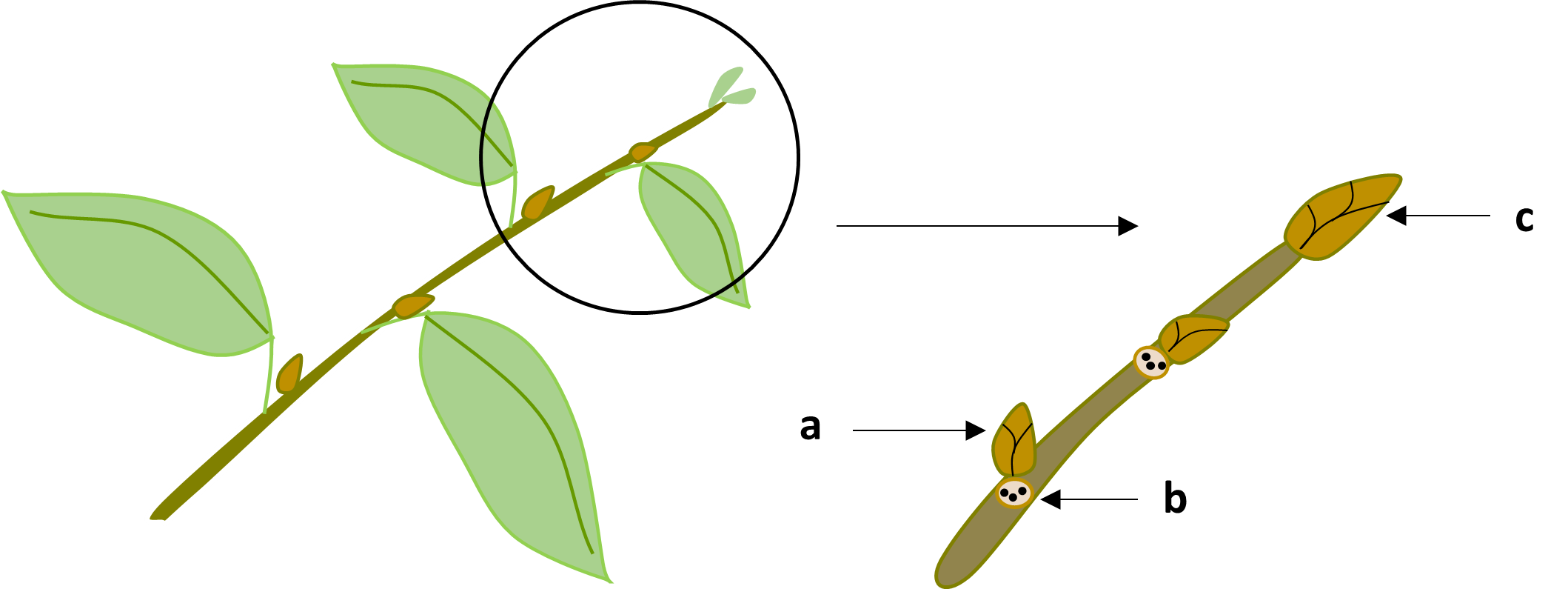
At the same time, growth stops at the tip of the stem and the young shoot is enclosed in either bud scales or protective leaves. This is a true terminal bud (c). It has no leaf scar (b) below it, and it is often larger than lateral buds (a). 

A diagram of a branch that develops a true terminal bud, labeled "c," and lateral buds and leaf scars, labeled "a" and "b."
I


False terminal buds

Now consider a stem that, instead of forming a terminal bud, dies back to the closest lateral bud. This is a false terminal bud. It has a leaf scar below it and is about the same size as other lateral buds.

The stub of the withered stem may project above the base of the bud on the side opposite the leaf scar. The mark it leaves, called a branch scar (b), can be mistaken for a leaf scar, but it won’t have vascular bundle scars. This can be hard to see without a hand lens. Also, in some species with false terminal buds, the bud is noticeably angled toward or away from the twig (a).

A diagram of a branch that develops a false terminal bud, labeled "a," and the branch scar that sits above the base of the bud, labeled "b."


Examples

Black Walnut (Juglans nigra) is a tree with alternate buds (a) and heart-shaped or three-lobed leaf scars. The true terminal bud (b) is larger than the lateral buds and does not have a leaf scar. The last lateral bud (c) sits just below the terminal bud. 

A series of three photos showing lateral and true terminal buds of black walnut.


American Elm (Ulmus americana), another tree with alternate buds, has false terminal buds. In the photos below, a branch scar is evident above the base of the bud (a) and a leaf scar (b) is on the opposite side, below the bud. Like some other species with false terminal buds, the bud is angled. 

A series of three photos showing the false terminal bud, leaf scar and branch scar on a winter twig of American elm.


Silver Maple (Acer saccharinum) is a tree with opposite or paired lateral buds (a) and a true terminal bud (b) that is larger than the lateral buds and has no leaf scar (c). The last pair of buds (d) sits just below the terminal bud. 

Two photos showing the true terminal bud, opposite lateral buds and leaf scars on a winter twig of silver maple.


Basswood (Tilia americana) is a tree with alternate lateral buds and false terminal buds. Below, the false terminal bud has a leaf scar (a) and is about the same size as the lateral bud below it. The branch scar (b) is smaller and darker than the leaf scar. 

A panel of three photos showing the false terminal bud, leaf scar and branch scar on a winter twig of basswood.


Highbush Cranberry (Viburnum trilobum, V. opulus) is a shrub with opposite buds. It does not form terminal buds of any kind. Instead, in fall, the ends of the stems (a) wither back to the last pair of opposite buds (b), which will resume growth in spring. As this pattern repeats, the shrub branches in a Y-shaped form called sympodial growth (c).


Two photos showing stems of highbush cranberry withered back to the last pair of opposite buds. One photo shows the Y-shaped branching pattern that results from the growth of the lateral buds in spring.


Some Winter ID Guides

The following guides can help with winter ID of trees and shrubs. When using any guide or key, look at several twigs and buds to see what’s typical. Variations are common.

The LEAF Program from UW-Stevens Point is a K-12 forestry education initiative that offers many online resources. Under Curriculum & Resources, choose LEAF Tree Identification Tools. The LEAF Winter Tree ID Key is available there as a downloadable PDF.

Pocket Reference for Winter Tree Identification. Champaign County Forest Preserves, Mahomet, IL.

Fruit and Twig Key to Trees and Shrubs, by William M. Harlow, PhD. Reprint edition, 1959. Dover Publications, Inc., New York. ISBN 0-486-20511-8. 


Monday, December 19, 2022

Winter Identification of Deciduous Trees and Shrubs

Several ironwood trees with brown leaves in a snowy understory.


In winter, trees and shrubs can be identified using twigs, bark, overwintering fruit and sometimes leaves. This post offers some tips and terms for winter ID. A printable version is available for free through the Downloads tab.  


Tip #1: If they're within reach, look at twigs. 


A twig of green ash showing nodes, brown, blunt buds, and pale, semicircular leaf scars.


As in this photograph of Green Ash (Fraxinus pennsylvanica), look for the size, color, shape and texture of terminal, or end, buds and lateral, or side, buds (b). Lateral buds are attached at nodes (a) and are arranged in one of four patterns:
  • Alternate: One bud per node   
  • Opposite: Paired, or two buds per node
  • Subopposite: Paired but not quite opposite
  • Whorled: Three buds per node
Green Ash has opposite buds (d). 

The size and shape of leaf scars (c) can also help identify a species. These scars are left by petioles, or leaf stalks, when they fall from the tree. Green Ash typically has light, semicircular leaf scars.


Tip #2: Within leaf scars, look for vascular bundle scars.


These scars are made when strands of water- and food-conducting cells are severed in fall. Their size, number and arrangement are typical for a species. Some are easier to see with a magnifying lens. 

A series of three photos showing the vascular bundle scars of green ash, red elderberry and Catalpa.


Above left: Green Ash bundle scars are small, brown dots arranged in a semicircle.
Center: The bundle scars of Red Elderberry (Sambucus racemosa) are raised, irregular shapes arranged at the points and along the sides of a triangular leaf scar. 
Right: The bundle scars of Northern Catalpa (Catalpa speciosa) are light brown dots arranged in an oval.


Tip #3: Look at bark. 

Bark color and texture are helpful clues but can change with age. Also look for lenticels, spots or irregular shapes on the bark of younger trees or shrubs. In the photographs of Green Ash below, lenticels are the white spots on the reddish-brown bark of the sapling shown on the left (arrows).

On the right is a mature Green Ash showing the typical honeycomb-like pattern of ridges and furrows of its bark.

Two photos showing the reddish-brown, speckled bark of a green ash sapling and the gray, honeycombed bark of a mature tree.


Tip #4: Look for overwintering fruit.

Some species retain their fruits, or parts of them, well into winter. Also look under the shrub or tree for fruits that may be on the ground or on top of the snow.

A panel of four photos showing the overwintering fruits of winged burning bush, box elder, Kentucky coffee tree, and Amur cork tree.

Clockwise from top left: Red capsule walls of Winged Burning Bush, Euonymus alatus; samaras of Box Elder, Acer negundo; pods of Kentucky Coffee Tree, Gymnocladus dioicus, each 3 to 4 inches (7-10 cm) long; and the fruits of Amur Cork Tree, Phellodendron amurense. 


Tip #5: A few species hold on to their leaves.

Some trees are marcescent -- their leaves turn brown but aren't shed in fall. In this region, oaks (Quercus), Ironwood (Ostrya virginiana) and Blue Beech (Carpinus caroliniana) are among the few trees that are marcescent. 

Below is Ironwood, an understory tree that retains its leaves through winter. 

Ironwood trees with brown leaves in a snowy understory.


Tip #6: Remember MAD Cap Buck Horse.

Bud arrangement -- alternate, opposite, subopposite or whorled -- can quickly narrow choices for identification. One way to remember which species have an opposite arrangement is the mnemonic MAD Cap Buck Horse:

M            Maples (Acer)

A            Ash (Fraxinus)

D            Dogwoods (Cornus, except for alternate-leaved dogwood, C. alternifolia)

Cap        Plants that are or were in the family Caprifoliaceae, including honeysuckles (Lonicera), wolfberry or snowberry (Symphoricarpos), elderberry (Sambucus) and viburnums (Viburnum). 

Buck Horse    Ohio Buckeye (Aesculus glabra) and Horse Chestnut (Aesculus hippocastanum)


Although this mnemonic is helpful, it doesn't include all trees and shrubs with opposite buds. For example, Wahoo and Burning Bush, genus Euonymus, also have opposite buds. So does Bladdernut, Staphylea trifolia, an understory shrub.

Most remaining species have alternate buds. Common Buckthorn, Rhamnus cathartica, is unusual in having subopposite buds. Catalpa, another unusual species, has whorled buds. 


Tip #7: Look at the pith.

The pith is the center of a branchlet or twig. The appearance of the pith -- hollow or solid, color, texture -- can help confirm the identity of a tree or shrub. For example, honeysuckle shrubs (Lonicera, left photo below) have hollow piths, and Red Elderberry (Sambucus racemosa, right photo below) has a soft, yellow pith.

Two photos showing the cut twigs of honeysuckle and red elderberry.


Tip #8: Try these guides.

The LEAF Program from UW-Stevens Point is a K-12 forestry education initiative that offers many online resources. Under Curriculum & Resources, choose LEAF Tree Identification Tools. The LEAF Winter Tree ID Key is available there as a downloadable PDF.

Pocket Reference for Winter Tree Identification. Champaign County Forest Preserves, Mahomet, IL.

Fruit and Twig Key to Trees and Shrubs, by William M. Harlow, PhD. Reprint edition, 1959. Dover Publications, Inc., New York. ISBN 0-486-20511-8. 


Thursday, March 31, 2022

Flower Parts for Plant ID

White flower of large-flowered Trillium blooming on a forest floor.
Large-flowered Trillium, Trillium grandiflorum


Thanks to the four biomes that meet here, Minnesota hosts a diversity of plant life. According to the most recent MNTaxa plant checklist, the state is home to at least 2,250 species and varieties of vascular plants (1). Of those, about 94% are flowering plants, and most guidebooks focus mostly or entirely on that group. To help identify these plants, many wildflower guides rely on flower parts – their presence or absence, their number, their appearance –to arrive at a plant's name.

It’s useful, then, to know how flowers are put together. This post introduces basic flower structure, beginning with the names of flower parts and some common variations and then introducing some terms for flower clusters, called inflorescences. 

Flower parts

In a model flower, parts are organized in four whorls. From outermost to innermost, they are sepals, petals, stamens and one or more pistils. In some flowers, pistils are composed of joined parts, called carpels (seed leaves), to form a compound pistil. In others, the pistils are composed of only one carpel, so they’re called simple pistils. The diagram below shows a simple pistil.

Flower diagram showing sepals, petals, stamens and pistils.


All the sepals together form the calyx, from a Greek word describing a husk or a case for a bud. Many flower buds are enclosed in and protected by a calyx before they open. Similarly, all the petals together form the corolla, from a Latin word meaning wreath or crown.


Buds and pink flower of wild geranium showing calyx and corolla.


Each of the flowers below has all four parts. Sharp-lobed hepatica has flowers with multiple stamens, multiple simple pistils, five petals, and five sepals. Large-flowered trillium has three sepals, three petals, six stamens, and one compound pistil formed of three joined carpels. Three stigmas emerge from the top of the pistil.


Hepatica and large-flowered Trillium with four floral whorls.


The photo of wild geranium below shows two flowers in different stages of development. In the left flower, stamens are at peak maturity and are releasing pollen. The pistil in this flower is immature and hidden by the stamens. In the right flower, the stamens are past peak and are withering. The pistil, however, is in its prime, with five, curved stigmas ready to accept pollen.

Two pink wild geranium flowers at different stages of maturity.

Because the stamens and pistils mature at different times, the flower can’t pollinate itself. This difference in timing, called dichogamy (dy-COG-amee), favors cross-pollination and mixing of genes, creating more diverse -  and perhaps more successful – offspring. 

Tepals

Tepals are petals and sepals that look alike. They are especially common among plants in the lily family and its close relatives. Tulips and day lilies are two garden favorites that have tepals. Native white trout lily and blue-bead lily also have tepals.

Tepals of white trout lily and blue bead lily flowers.


Regular (actinomorphic) and irregular (zygomorphic) flowers

When viewed face on, regular flowers look like wheels or stars: Their parts are evenly distributed all the way around. More than one line can be drawn through the center of the flower to create similar halves. Such flowers are also called radially symmetric or actinomorphic, which means star-shaped.

In contrast, irregular flowers have only one plane of symmetry: Only one line can be drawn across their faces to produce similar halves. Irregular flowers are also called bilaterally symmetric or zygomorphic. “Zygo” is a Greek prefix meaning pair.

Regular flower of white avens and irregular flower of spotted jewelweed.


Complete and incomplete flowers

If flowers have all four parts – sepals, petals, stamens and pistils – they’re complete. If they’re missing one or more of these parts, they’re incomplete. Wild strawberry, for example, has complete flowers. The flowers of Canada anemone, however, have no petals and are incomplete. In that plant, sepals are the large, colorful parts that attract pollinators.

Flowers of wild strawberry and Canada anemone.


Perfect and imperfect flowers

These terms refer to the reproductive parts of a flower, the pistils and stamens. A perfect flower has both parts, whereas an imperfect flower has only one. A staminate flower has only stamens; a pistillate flower has only pistils.

If a species has imperfect flowers and the staminate and pistillate flowers are on the same plant, the species is monoecious (mon-EE-shus), meaning one house. If the species has staminate and pistillate flowers on different plants, it is dioecious (dy-EE-shus), meaning two houses. Sometimes dioecious plants are said to have separate “female” and “male” individuals.

Most flowers of silver maple, for example, are imperfect. Staminate and pistillate flowers are shown below. They may be on separate trees or on the same tree, so the plants can be dioecious or monoecious, respectively. Occasionally, a tree may also have perfect flowers.


Silver maple staminate and pistillate flowers.


Wind-pollinated flowers

Wind pollinated flowers don’t rely on insects to visit them, so they lack showy petals and sepals. Stamens and stigmas, however, are often numerous and obvious when the flowers mature. Silver maple, shown above, is wind pollinated, as are willows and aspens. Grasses are also wind pollinated. Two  prairie grasses, big bluestem and Indian grass, are shown below.

Protruding anthers and feathery stigmas of big bluestem and Indian grass.


Inflorescences

Some plants, like tulips or roses, produce flowers singly. Others produce flowers in clusters called inflorescences.

An aster, for example, isn’t one flower but many tiny ones, all clustered on a flat, rounded, or conical receptacle. The flowers in the center are called disk flowers. Those around the edge, often bearing petal-like rays, are called ray flowers. This arrangement, called a head inflorescence, is typical of plants in the aster or sunflower family.

Diagrams and photos of a head inflorescence and other common types are below. In the diagrams, black circles represent flowers. Different sizes of circles indicate that some flowers in an inflorescence mature sooner than others. The larger the circle, the earlier it opens. If all circles are the same size, they mature at the same time.


Head inflorescence of New England aster.


Spike of white prairie clover flowers and catkin of willow flowers.


Racemes of black cherry and Dutchman's breeches flowers.


Panicle of white flowers of false Solomon's seal.


Compound umbel of water hemlock flowers and fruits.


Compound corymb of yellow-green Norway maple flowers.


Cyme of St. John's wort.


Mixed inflorescences

Adding more challenge, some plants have mixed or combined types of inflorescences. Rough Blazing Star, for example, has heads arranged in a spike, and Showy Goldenrod has heads arranged in a panicle.

Spike of heads of rough blazing star and panicle of heads of showy goldenrod.


References

(1) MNTaxa: The State of Minnesota Vascular Plant Checklist. Minnesota Department of Natural Resources. Accessed March 30, 2022, online at https://www.dnr.state.mn.us/eco/mcbs/plant_lists.html.

(2) Minnesota Wildflowers: A field guide to the flora of Minnesota. Online at minnesotawildflowers.info.


Plant Profile: Prairie Ironweed

Prairie ironweed, Vernonia fasciculata Michaux Widely considered a pollinator magnet, prairie ironweed, also called common, smooth, or fasc...