Tuesday, February 22, 2022

Simple and Compound Leaves

Left: Zigzag Goldenrod, Solidago flexicaulis. Right: Black raspberry, Rubus occidentalis.


Plant identification guides and keys often describe leaves as either simple or compound. This characteristic is helpful in pinpointing an ID because plants tend to be consistent in the type of leaf they have: simple, compound, or a unique combination of the two.

With a little practice, it's easy to tell the two apart. Simple leaves have continuous blades, like the one in the photo of Zigzag Goldenrod above. In contrast, compound leaves have blades divided into leaflets, like the five-parted leaf of Black Raspberry, also shown above.

The leaflets of compound leaves can be arranged in one of two patterns: Pinnate or palmate. Pinnately compound leaves have leaflets arranged along a central stalk, like pinnae on a feather. Palmately compound leaves look somewhat like a hand: The leaflets radiate from a common point, like fingers on a palm. 

Pinnately compound leaves can be divided further, with primary leaflets divided again into secondary and sometimes tertiary leaflets.  Leaves that are divided two, three or more times look fern-like.

For more information about simple and compound leaves, including examples of the types described above, see this video tutorial

Tuesday, January 25, 2022

Alternate, Opposite, Subopposite and Whorled Leaves


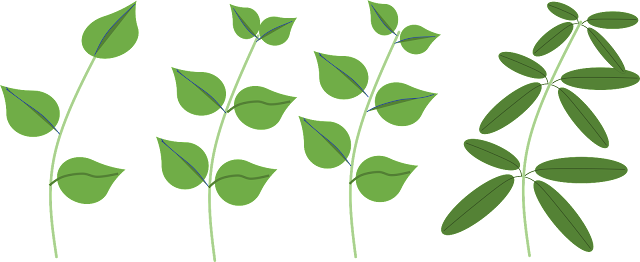
An illustration of alternate, opposite, subopposite and whorled leaves.

Many plant identification guides group species by how their leaves are arranged on their stems. From left to right above are four common patterns:

  • Alternate: One leaf per node
  • Opposite: Two leaves per node
  • Subopposite: Almost opposite
  • Whorled: Three or more leaves per node.

Looking for the leaf arrangement is a good first step to identifying a plant. For more examples, see this video tutorial. 


Thursday, December 16, 2021

City Trees Green Up Earlier

 A recent study found that trees in cities leaf out in earlier in spring than those in rural areas.  This post explains what happens as deciduous (leaf-shedding) plants enter and leave dormancy, and how a shift in timing could have ripple effects.

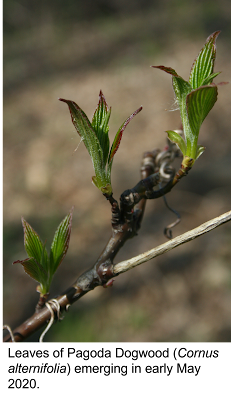
A branch of Pagoda dogwood in spring with leaves starting to emerge.
It is December, and the trees are, in their way, asleep. They are dormant, quieted by the declining temperatures and longer nights that signal a time of harsh conditions.

They will have a long nap. Last summer many deciduous trees began covering their buds – next year’s hope of growth – in protective scales. In autumn the leaves gave it up. The chlorophyll, proteins and sugars in their blades broke down or withdrew into branches, trunks and roots to be stored over winter.

As their substance retreats, leaves become liabilities. Through stomates, small pores on the surfaces of their blades, leaves continue to lose water that can’t be replaced from frozen soil. To prevent desiccation, the leaves are cut off.  Invisible lines of cells, called abscission layers, form on the leaves’ petioles, like tear-off lines that mark where they will separate from the trees. Some leaves offered a colorful sendoff and fell. Others, those with abscission layers not quite complete, are still hanging on, rattling in the winter wind.

Although they are dormant now, the trees are primed to renew their growth in spring. After enough cold days have accumulated and as days grow longer, they will begin to stir. As in all aspects of plant growth, timing is everything. If buds break too early, say in an unusually warm February, new growth would likely be damaged by a returning freeze. To avoid this, day length acts as a check. Even if buds have been adequately winter-chilled and temperatures then rise, short days (long nights) are a sign that winter isn’t over, and growth will not resume.

Timing is important not only to avoid freezing, but also to attract pollinators. Insect-pollinated trees and shrubs, especially those that are native here, have long relationships with native insects. Time of flowering may coincide with time of insect emergence and vice versa, each benefiting from the presence of the other. If plants flower earlier than normal, their pollinators may not yet have emerged, or if it's too cold, they may not be active. 

If timing of life events -- phenology -- depends on external cues, what happens when temperature and light are altered? Does a tree’s phenology change when environmental indications change, such as in warmer and artificially brighter cities?

Yes, according to a recent study that looked at satellite and phenological data around the globe (1). According to the study, on average, spring green-up occurs six days earlier in cities compared to rural areas, due mostly to warmer urban temperatures.  When photoperiod – daylength– is factored in, the effect is greater. Urban trees exposed not only to warmer temperatures but also to lights on streets, parking lots, billboards and other artificial sources leafed out an average nine days earlier than rural trees. It's thought that night length, normally a check on early leaf-out, is shortened by city light, and the trees are “tricked” into resuming growth in artificially warmer and brighter conditions. 

The study raises several questions, especially about climate change.  If a warming climate causes trees to green up earlier even in the countryside, would rural darkness limit how much earlier they resume growth? In other words, without city lights, would winter's long nights continue to serve as a check on how early the trees leaf out?

Also, could warm urban winters, made even warmer by climate change, prevent city trees from accumulating enough cold exposure to leaf out early, even if nights are artificially short and spring-like? 

If trees do leaf out and flower early, will allergy season also start earlier? How will insects adapt to the change? Will their phenology shift, too?

These questions can be answered by part by continuing to observe the phenology of plants and animals. Both citizens and scientists are important in that effort. By recording when trees, shrubs and other plants leaf out, flower and form seeds, they contribute to an understanding of what triggers these life events and how their timing might be shifted by environmental changes. 

To learn more about phenology and how to help observe seasonal changes, open the Phenology tab.  

References

(1) Meng, Lin. 2021. “Green with phenology.” Science Vol. 374, Issue 6571 (November 25, 2021): 1065-1066. DOI: 10.1126/science.abm8136

Dr. Meng’s study is also discussed in a National Public Radio interview at https://www.npr.org/2021/11/29/1059861862/climate-change-and-city-lights-are-tricking-trees-into-growing-leaves-too-soon


Sunday, November 14, 2021

Wax Plant in its Waning Days

 Four dried stems of wax plant topped by light brown capsules splitting vertically.

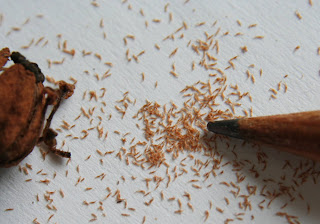
These are the dried stems and capsules of wax plant (Monotropa uniflora L.). The capsules at the tops of the stems split open to release winged seeds no bigger than a millimeter. That’s about as big as the tip of a pencil.

A mass of tiny, light brown seeds of wax plant.

Carried by wind to other places on the forest floor, the seeds will germinate only in the presence of certain fungi that help them grow. These fungi also connect to tree roots, forming associations called mycorrhizae (MY-co-RY-zee). It’s a mutually beneficial relationship. The fungi help gather nutrients for the trees, and the trees provide carbon (sugars) for the fungus.

Wax plant taps that connection. The plant isn’t photosynthetic, so to support its growth it diverts carbon and nutrients from mycorrhizal fungi into its own roots. Because it gives nothing in return, wax plant is a parasite on the fungus. Such plants are called myco-heterotrophs: They get energy and nutrition from fungi.

Being a myco-heterotroph allows wax plant to survive in deep shade. It doesn’t depend on sunlight – it has no chlorophyll to absorb light – so it can grow in dark forest interiors where there is little competition from other plants. The trade-off is its dependency on mycorrhizal fungi for much of what it needs to survive. The thread from tree to fungus to wax plant is both a lifeline and a liability.

More About Wax Plant
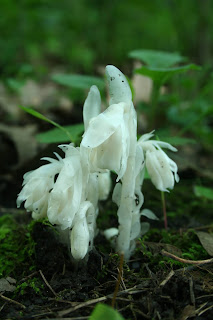
A cluster of white, nodding stems of wax plant.

The name wax plant comes from the plants' white, waxy-looking stems. Other common names are ghost plant and corpse plant. It's also called Indian pipe from the resemblance of its curved flowering stems to Native American ceremonial pipes.

Although it's often mistaken for a fungus, wax plant is a flowering plant. In Minnesota, stems emerge in mid to late summer. Flowers are visited by a variety of insects, but they are pollinated primarily by bumblebees. After pollination the hooked stems straighten, darken, and develop seed-bearing capsules. 

The name Monotropa means “one turn,” referring to the nodding stems of the plants in bloom. The species name uniflora means “one-flowered.” Typically, each stem bears only one flower.

Wax plant grows in rich, forested habitats in much of North America. This circumboreal species also grows in Asia.

Garlic mustard (Alliaria petiolata), an invasive plant that can also grow in shade, could be harming wax plant and other myco-heterotrophs. Chemicals in garlic mustard are known to interfere with establishment of other mycorrhizal relationships, and they may be doing the same to wax plant.

References

Monotropa uniflora (Indian Pipe). Minnesota Wildflowers. Viewed November 11, 2021, at https://www.minnesotawildflowers.info/flower/indian-pipe.

DeLay, Chantelle. Undated. Plant of the Week: Ghost Pipe (Monotropa uniflora L.). USDA, U.S. Forest Service. Viewed November 10, 2021, at Ghost Pipe (fs.fed.us).

Monotropa uniflora Linnaeus. Flora of North America, Vol. 8. Viewed November 13, 2021, at Monotropa uniflora in Flora of North America @ efloras.org.

Volk, Thomas. 2002. Tom Volk’s Fungus of the Month for October 2002. Accessed November 13, 2021, at http://botit.botany.wisc.edu/toms_fungi/oct2002.html.

Klooster, M. R., & Culley, T. M. (2009). Comparative Analysis of the Reproductive Ecology of Monotropa and Monotropsis: Two Mycoheterotrophic Genera in the Monotropoideae (Ericaceae). American Journal of Botany, 96(7), 1337–1347. https://www.jstor.org/stable/27733466

Martine C.T. and Hale,  A.N. (2015.) Parasitism disruption a likely consequence of belowground war waged by exotic plant invader. Am J Bot. 2015 Mar;102(3):327-8. doi: 10.3732/ajb.1500025. Epub 2015 Mar 2. PMID: 25784465. Viewed 11-12-2021 at https://pubmed.ncbi.nlm.nih.gov/25784465/


Wednesday, November 3, 2021

How Did Bittersweet Nightshade Get Its Name?

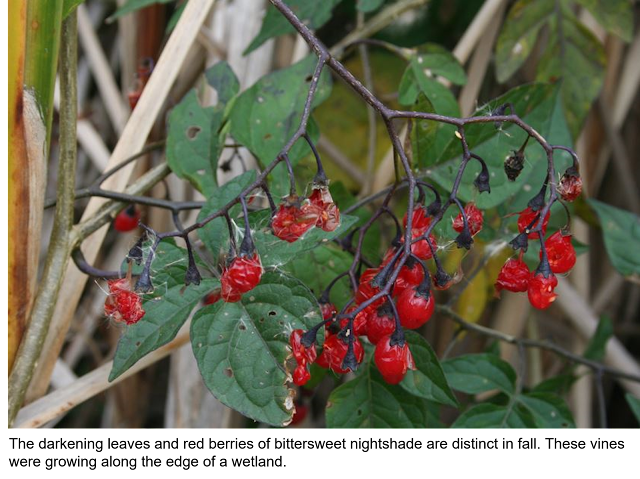
Branchiing stems of bittersweet nightshade with dark green leaves and red berries.

Warning: Bittersweet nightshade is poisonous. Don’t eat it.

Bittersweet nightshade, Solanum dulcamara, takes part of its common name from its taste. Its leaves and stems taste bitter and then sweet as its chemical components break down. The species name dulcamara comes from that quality. It's a combination of the Latin root words dulc, meaning sweet, and amar, meaning bitter.

The origin of “nightshade” isn’t as clear. One explanation is that it comes from the narcotic effect of many plants in the genus Solanum. Bittersweet nightshade and its relatives contain solanine, an alkaloid that affects the nervous system. The solanine content of this plant is highest in its leaves and green fruits but eating any part can cause stomach upset, drowsiness, dizziness, delirium and in severe cases respiratory failure and death.

Less ominously, “nightshade” could also come from the shady habitats where these plants may grow. Another origin could be the black berries that some Solanum species produce. Bittersweet nightshade isn’t one of them – its fruits are red at maturity – but other nightshades are well known for their black fruits.

One of them is the highly toxic Atropa belladonna, commonly known as deadly nightshade or simply belladonna. The black berries of this plant are high in atropine, an alkaloid now used to dilate pupils for eye exams, treat low heart rates and counteract other poisons, among other medical uses. In earlier times, however, people used belladonna for other purposes, with some risk. During the Renaissance, Venetian women dropped diluted berry juice into their eyes to dilate their pupils, a look considered beautiful at the time. That effect is captured in the species name belladonna, meaning “beautiful woman.” 

There were darker uses for belladonna. Ancient Romans are said to have incapacitated or killed their enemies by contaminating their food supply with the plant, and stories abound of its use as an assassin’s poison. Accidental poisonings still occur from misuse of herbal products or ingestion of berries mistaken for blueberries or other edible fruits.

Bittersweet nightshade isn’t as poisonous as belladonna, but it’s still best to be cautious. Its name speaks of its chemistry and the long, sometimes perilous history of the nightshade group. Before grabbing a handful of its berries, heed its name. It says beware.


More about Bittersweet Nightshade


Also called woody nightshade or climbing nightshade, bittersweet nightshade is an
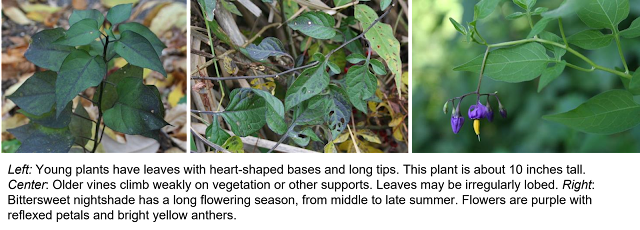
introduced vine now found throughout much of North America. It’s often associated with disturbed sites, especially those with wet or moist soils. Wetland edges, lakeshores, riverbanks, and deciduous forests are typical habitats. The vine grows up to twenty feet long, clambering over other plants or weakly twining around trees, shrubs or fences for support. In this region, bittersweet nightshade flowers from June to September. Fruits are oval, tomato-like berries about ½ inch long. They ripen from green to yellow, orange and eventually red. 


A young plant, older vine and purple flowers of bittersweet nightshade.


This introduced plant can be aggressive, especially in wet habitats that favor robust growth. It should be removed from places where children, pets or livestock may eat its leaves, stems or fruits.

Bittersweet Nightshade is in the family Solanaceae, a group that also includes tomatoes, peppers, eggplant and potatoes. Tomatoes, peppers and eggplants are edible fruits; they contain little or no solanine. Potatoes tubers are also edible unless they’re exposed to sun and turn green from chlorophyll. Chlorophyll isn’t poisonous, but it shows that solanine may have accumulated in the tuber and could cause illness.


References

USDA Forest Service. The Powerful Solanaceae. Solanaceae (fs.fed.us). Website accessed October 30, 2021.

Kandeler, R., and Ullrich, W.R. Symbolism of plants: examples from European-Mediterranean culture presented with biology and history of art: August: bittersweet, woody nightshade. https://www.cabi.org/isc/abstract/20093251708. Website accessed October 30, 2021.

Flora of Wisconsin. Solanum dulcamara. https://wisflora.herbarium.wisc.edu/taxa/index.php?taxon=8664. Website accessed October 29, 2021.

Waggy, Melissa A. 2009. Solanum dulcamara. In: Fire Effects Information System, [Online]. U.S. Department of Agriculture, Forest Service, Rocky Mountain Research Station, Fire Sciences Laboratory (Producer). Available: https://www.fs.fed.us/database/feis/plants/shrub/soldul/all.html [2021, October 27].


Sunday, August 22, 2021

Plant Profile: Brown-eyed Susan

 Flowers of brown eyed Susan with yellow petals and dark brown, mounded centers.


Brown-eyed Susan, Rudbeckia triloba, is a rare find in the wild. Although this native annual or short-lived perennial grows throughout the eastern U.S., it reaches the northwest limit of its natural range in Minnesota. Here it’s a state-threatened species, documented in open woods and floodplain forests in a handful of counties in the southeast part of the state. Both habitats continue to lose ground due to land conversion and invasive plants such as common buckthorn, making a natural population of brown-eyed Susan an exceptional discovery.

Although wild populations of brown-eyed Susan are hard to find, intentional plantings are not. This late-summer bloomer is popular in gardens and naturalized landscapes across the state. It’s in its peak season of flowering in late summer, an ideal time to look for and identify this plant.

How to Identify Brown-eyed Susan

Brown-eyed Susan is easiest to recognize by its profusion of 1- to 2-inch-wide flower heads. Each head is a collection of small flowers called florets. The center of the head, called the disk, is a button-shaped, mounded or conical structure bearing dark purple to brown disk florets. Around the disk are 6-13 ray florets, small flowers bearing a single, yellow-orange, petal-like ray. The rays are grooved along their length and have small notches at their tips. Flowering is from August into October (2, 3, 4).

Brown-eyed Susan can also be identified by its leaves and stems. It’s a tall plant, commonly 2-4 feet but up to 5 feet, with reddish, bristly stems. The leaves are also bristly on both surfaces. The lower leaves often have three lobes, the source of the specific name triloba and another common name, three-leaved Rudbeckia. (The latter is a misnomer; lower leaves are three-lobed but are not divided into three leaflets.) The lobed, lower leaves are stalked, whereas the upper leaves are lance-shaped or elliptic with short or no stalks. Because the plant tends to branch widely, it can look bushy, but smaller plants have fewer branches.

As noted above, natural habitats are low, open woods and floodplain forests, but brown-eyed Susan also grows in the moist soils of thickets and stream banks (4). Favorable garden locations should provide sun to part shade and moist, loamy soils.

Look-Alikes

Black-eyed Susan (Rudbeckia hirta) and orange coneflower (Rudbeckia fulgida) are the most common look-alikes. Compared to either species, brown-eyed Susan is taller and more branched with reddish-green stems. Its flower heads are 1-2 inches across, smaller than other Rudbeckia species. Brown-eyed Susan also blooms later and longer into fall.

Sweet Coneflower (Rudbeckia subtomentosa) is also like Brown-eyed Susan. Its natural range barely extends into southeastern Minnesota from its broader range to the south and east. Like Brown-eyed Susan, it is a tall plant – up to 6 feet – and some of its leaves may be three-lobed. However, its flower heads are wider, 2-3 inches across, and both the leaves and the bracts below the heads are described as being dotted with glands (2). This may require a magnifying lens to see. Although rare in the wild, sweet coneflower is planted in gardens.

Wild golden glow (Rudbeckia laciniata), another look-alike, grows 5-10 feet tall in moist thickets, woodland edges, swamps and floodplains (2). Unlike brown-eyed Susan, its flower heads are 2-3 inches across. Its leaves are much larger – up to 10 inches long with three to seven deep lobes. For that reason, wild golden glow is also called cut-leaf coneflower.

Below are photographs of brown-eyed Susan and two of its look-alikes, black-eyed Susan and orange coneflower.

Brown-eyed Susan, Rudbeckia triloba. Stems are widely branched, reddish-green, and bristly. Flower heads are 1-2 inches wide. Bracts are hairy-bristly, tapered, and of unequal length. Lower leaves are three-lobed and coarsely toothed (2). 


Black-eyed Susan, Rudbeckia hirta. Plants are up to 3 feet tall with few branches. Flower heads are 2-3 inches wide with numerous, densely hairy, tapered bracts. Stems are green and densely hairy (hirta is from the Latin prefix hirt, meaning hairy or rough). Leaves are densely hairy on both surfaces, lance-elliptic, and with edges that are smooth or finely toothed.


Orange Coneflower, Rudbeckia fulgida, is native to the eastern U.S. but not Minnesota (5). It is common in gardens. Plants are up to 3 feet tall and somewhat branched. Flower heads are 2-3 inches wide with bracts that are more sparsely hairy than either Brown-eyed or Black-eyed Susan. Stems are green and bristly-hairy. Largest leaves are coarsely toothed but not lobed. Cultivars of Orange Coneflower may have slightly different characteristics. 


References

(1) Minnesota Department of Natural Resources, Division of Ecological and Water Resources. 2018. Rare Species Guide: an online encyclopedia of Minnesota's rare native plants and animals [web application]. Minnesota Department of Natural Resources, St. Paul. www.dnr.state.mn.us/rsg. Accessed August 19, 2021.

(2) Minnesota Wildflowers. Webpages for Rudbeckia triloba, R. hirta, R. laciniata, and R. subtomentosa accessed August 19-21, 2021, at  https://www.minnesotawildflowers.info/.

(3) Brown-eyed Susan, Rudbeckia triloba. Wisconsin Horticulture, Division of Extension, University of Wisconsin-Madison. Website accessed August 19, 2021, at https://hort.extension.wisc.edu/articles/brown-eyed-susan-rudbeckia-triloba/

(4) Tallgrass Prairie Wildflowers: A Field Guide. 1995. Text by Douglas Ladd, Photos by Frank Oberle. Published by Falcon Publishing, Inc., in cooperation with The Nature Conservancy.

(5) USDA, NRCS. 2021. The PLANTS Database (http://plants.usda.gov, 08/21/2021). National Plant Data Team, Greensboro, NC USA. [Web page for Rudbeckia fulgida accessed 8/21/21 at https://plants.usda.gov/home/plantProfile?symbol=RUFU2.]


Friday, July 30, 2021

Exotic Honeysuckles Change Feather Color

The finding underscores the unpredictability of invasive plant impacts.


A branch of Tatarian honeysuckle in July with orange-red fruits.
Tatarian Honeysuckle (Lonicera tatarica) in early July. The fruits remain on the plant into August.

Most introduced plants – species imported from their natural ranges – are not harmful. The introductions that damage the environment, the economy or human health are called invasive, and their stories are much alike.

Arriving by accident or on purpose and without predators or pathogens to check their spread, invasive plants escape and eventually dominate areas outside cultivation, outcompeting native plants for water, nutrients and light. Some of them change soil chemistry or host other invasive species, further altering the communities they invade.

To a large extent, that’s the story of exotic bush honeysuckles. Four species are present in Minnesota and neighboring states: Tatarian Honeysuckle (Lonicera tatarica), Morrow’s Honeysuckle (L. morrowii), Bell’s Honeysuckle (L. x bella) and Amur Honeysuckle (L. maackii). All were introduced in the 1700s or 1800s as ornamentals, for erosion control or for wildlife habitat, and all are now recognized as invasive.  Once they are established, they displace native plants with their extended growing season, large, fast growth and prolific fruit production, which is their primary means of natural spread (1, 2). Together, their effect on native plant communities is considered second only to common buckthorn (2).

That’s sobering enough, but there’s another concern. Decades of observations have found that some birds are affected both indirectly by alteration of their habitats and directly by alteration of their appearance. Specifically, the berries of some exotic honeysuckles can change the color of their feathers, turning yellow parts orange and orange parts red.

Looking Back

The first reports of reddened feathers, called plumage erythrism, are from the early 1960s, when bird banders at Powdermill Nature Reserve in southwest Pennsylvania found Cedar Waxwings with orange tail bands instead of the normal yellow (3, 7). More observations followed, involving more species. White-throated Sparrows turned up with orange, not yellow, lores, the area between the base of the bill and the eye (4). Yellow-shafted Flickers, an eastern subspecies of Northern Flicker, were found with orange to red, not yellow, coloration on the undersides of their flight feathers (5). And since the early 1990s, male Baltimore orioles have been observed with red instead of orange feathers, particularly in the northeast U.S. and southeast Canada (6, 7).   

Left: An adult Cedar Waxwing, Bombycilla cedrorum. Photo by Ken Thomas via Wikimedia Commons. Notice the yellow tail band. Right: Tail band of a Cedar Waxwing showing normal yellow and abnormal orange color caused by deposition of rhodoxanthin. Photo courtesy Powdermill Nature Reserve, Carnegie Museum of Natural History.  


It took decades to find the cause. In the late 1980s, Jocelyn Hudon and Alan Brush, then with the University of Connecticut, analyzed the pigments in the yellow and orange tail bands of cedar waxwings. Along with several other pigments, they found rhodoxanthin, a red pigment then known primarily from the berries of yew (Taxus) and the leaves of some gymnosperms (Arborvitae, for example; (8).

Rhodoxanthin is different from the pigment that adds a splash of red to the birds’ wing tips. Because cedar waxwings can’t produce rhodoxanthin from other pigments they ingest, Hudon and Brush suspected it was introduced directly from the birds’ diet. In addition, because most of the birds with orange tail bands were juveniles, they suggested that the pigment came from something the nestlings were fed by their parents in July and August, when they were growing tail feathers. Whatever the food source was, they thought it was seasonally available, and because erythrism was recent – it was not documented in birds before the 1950s and 60s – the dietary source also had to be recent. They speculated:

If a dietary change is involved, the sudden appearance [of aberrant feather colors] might reflect the appearance of a new food source, a change in the abundance of a native or established source, or a change in adult food choice. (8)

Suspicions Confirmed

Speculation that change in feather color was caused by a change in food source was correct. Around the same time color aberrations were more widely observed, exotic bush honeysuckles were increasing in abundance. They and their cultivars were widely promoted and planted, and they found available habitat not just in landscapes and wildlife plantings but also in grasslands, brushlands and open woods, where they escaped. Feeding experiments and observations of wild birds confirmed that the source of rhodoxanthin was honeysuckle berries, especially those of Tatarian and Morrow’s Honeysuckle. Furthermore, plumage erythrism was found to affect not only nestlings but also adults that ate the berries during their summer molt. Rhodoxanthin consumed as they replaced their feathers was deposited like yellow or orange pigments, reddening the color of the tail bands (9, 10).

As exotic honeysuckles have spread, so have instances of plumage erythrism. Birders in the Midwest, including Minnesota and Wisconsin, have reported erythrism in cedar waxwings, white-throated sparrows and yellow-shafted flickers. Reports also come from Idaho, Montana, Utah and Alberta, Canada (10).

White-throated Sparrows (Zonotrichia albicollis) with normal yellow lores (left)
and abnormal orange lores (right). Photo courtesy Powdermill Nature Reserve,
Carnegie Museum of Natural History.

The consequences of changed feather color aren’t yet fully understood, but some ornithologists wonder if plumage erythrism could affect reproductive success (7, 10). Intensity of feather color is a measure of fitness. If males retain their reddened feathers into the breeding season, females may choose them over males that acquire their color “honestly,” that is, from activity and genetic advantage that signal better fitness. The result may be selection of breeding partners that are less able to produce and raise healthy offspring.

How to Help

The effect of exotic honeysuckle berries on feather color also points to the unexpected outcome of some plant introductions. Although not all introduced plants become invasive, those that do may have surprising – and still unknown – impacts on ecosystems, economies and health.

Fortunately, many landscape alternatives are available to anyone wanting to avoid the negative effects of invasive plants. Here are several sources of information.

  • To learn which plants are invasive, start with this Minnesota DNR web page or see the Invasive Species tab above.
  • To learn how to identify exotic honeysuckles, see this guide from MnDOT. More resources specific to introduced honeysuckles are listed on this Minnesota DNR web page.
  • If you decide to replace non-native plants with native ones, you may be encouraged to know that an effective planting can be any size. To learn how one ecologist and gardener converted her backyard into a diverse, pleasing habitat, read Home Is Where the Habitat Is from the Minnesota Conservation Volunteer.
  • If you’re looking for alternatives to invasive plants, there are many helpful resources. For trees, shrubs and woody vines, try the Landscapes Alternatives web page from the Woody Invasives of the Great Lakes Collaborative (WIGL). A free, downloadable brochure and a mobile app are available under the Landscape Alternatives pull-down menu.
  • Another resource is Landscape Alternatives for Invasive Plants of the Midwest, a brochure that can be downloaded at no cost from the Midwest Invasive Plant Network.
  • For lists of native plant suppliers and services, see the links under More to Explore, above right.

Finally, if you’re a birder, report any observations of birds with abnormally reddened feathers. This will help researchers learn more about the extent of plumage erythrism and its possible impacts. State ornithological societies and eBird may be appropriate places to submit reports. 

References

  1. Woody Invasives of the Great Lakes Collaborative. Species accounts for Amur Honeysuckle, Morrow’s Honeysuckle and Tatarian Honeysuckle accessed July 27, 2021. https://woodyinvasives.org/
  2. Smith, W R. (2008). Trees and Shrubs of Minnesota. University of Minnesota Press, Minneapolis.
  3. All About Birds: Cedar Waxwing, accessed July 23, 2021. https://www.allaboutbirds.org/guide/Cedar_Waxwing/overview.
  4. Powdermill Nature Reserve Avian Research Center, Carnegie Museum of Natural History. 2014 Late Fall bird banding report, https://powdermillarc.org/pictorial-highlights/late-fall-2014/. Accessed July 23, 2021.
  5. Hudon, J., Driver, R.J., Rice, N.H., Lloyd-Evans, T.L., Craves, J.A., and Shustack, D.P. (2016). Diet explains red flight feathers in Yellow-shafted Flickers in eastern North America. The Auk 134(1): 22-33. 
  6. Hudon, J., Derbyshire, D. Leckie, S., and Flinn, T. (2013). Diet-induced plumage erythrism in Baltimore Orioles as a result of the spread of introduced shrubs. The Wilson Journal of Ornithology 125(1): 88-96.  https://www.jstor.org/stable/41932838
  7. Flinn, T., Hudon, J., and Derbyshire, D. (2007). The Tricks Exotic Shrubs Do: When Baltimore Orioles Stop Being Orange. Birding magazine, September/October 2007.  https://www.aba.org/birding_archive_files/v39n5p62.pdf
  8. Hudon, J., and Brush, A. (1989). Probable dietary basis of a color variant of the Cedar Waxwing. J. Field Ornithol. 60(3): 561-568.
  9. Witmer, M.C. (1996). Consequences of an alien shrub on the plumage coloration and ecology of Cedar Waxwings. The Auk 113(4): 735-743.
  10. Hudon, J. and Mulvihill, R. (2018). Diet-induced plumage erythrism as a result of the spread of alien shrubs in North America. North American Bird Bander 42:95-103.
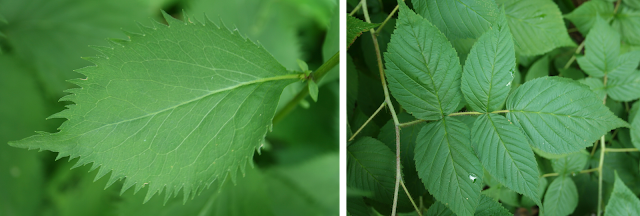
Plant Profile: Common Elderberry

  Sambucus canadensis or Sambucus nigra subsp. canadensis Common elderberry growing on the edge of a cattail marsh. The largest inflorescenc...