Monday, June 27, 2022

Plant Profile: Bunchberry

 Cornus canadensis L.

Bunchberry, Cornus canadensis, flowering in northern Minnesota in mid-June 2022.


Also called Canada dogwood or creeping dogwood, bunchberry is a patch-forming, herbaceous plant of cool, moist forests. Although it’s related to red osier dogwood (C. sericea), gray dogwood (C. racemosa) and similar shrubs, this plant has no aboveground woody growth. Mature plants are just 3-6 inches tall, their short stems tipped by four to six, arc-veined leaves that are so closely spaced they appear whorled.

In late spring or early summer, mature plants produce a cluster of 12-40 small flowers surrounded by four white bracts. The petals of the flowers are just 1-2 millimeters long (1) and fused along their edges until they open.

The stamens of the flowers grow quickly, faster than the petals. As they mature, their anthers, the pollen-producing tips of the stamens, are trapped inside the closed flowers, but their lengthening filaments bend outward between the petals. Eventually, a trigger – a visiting bumblebee, for example, or the building pressure within the flower– causes the flowers to open explosively. As the petals flip back, the stamens spring outward, and pollen is catapulted into the air (2,3). The grains can be lofted as high as 2.5 centimeters (25 millimeters) above the flower, ten times the height of the flower itself (3).


A single bunchberry flower opens explosively -- in about half a millisecond (3). When the petals are flung back, stamens are released and catapult their pollen. Illustration based on photographs in Whitaker, et al. (2). 


[Watch a video of an exploding flower here.]

If they’re launched at high enough speed, some of the pollen may catch in the hairs of flying insects, which then carry it to other plants. Other pollen rides the wind. Unlike plants that are pollinated only by insects, bunchberry pollen grains are smooth instead of sticky, and so more easily carried by a breeze (2).

A dual system of pollination is an advantage for bunchberry. These low-growing plants are self-incompatible, so they need pollen from other plants to form seeds. If insect pollination isn’t successful, wind pollination might be, but for the latter to work, pollen must be launched high enough to be wafted over a patch of the plants.

If either method of pollination succeeds, the plants will produce bunches of red drupes, fruits with single, stony seeds. The fruits look like berries, inspiring the name bunchberry.

Where to find bunchberry

Bunchberry typically grows in cool, moist broadleaf, coniferous or mixed forests. In North America, its range is primarily the northern tier of states, all of Canada, and Greenland (4). This circumboreal plant is also found at northern latitudes in Asia.

More information

For photos and more information about bunchberry, see the Minnesota Wildflowers page for this species.

References

(1) Flora of North America, efloras.org. Accessed online on June 27, 2022. Formal citation: eFloras (2008). Published on the Internet http://www.efloras.org [accessed 27 June 2022]. Missouri Botanical Garden, St. Louis, MO & Harvard University Herbaria, Cambridge, MA.

(2) Whitaker, D., Webster, L., and Edwards, J. (2007). The biomechanics of Cornus canadensis stamens are ideal for catapulting pollen vertically. Functional Ecology 21. 219-225. DOI:10.1111/j.1365-2435.2007.01249.x

(3) Edwards, J., Whitaker, D., Klionsky, S. et al. 2005. A record-breaking pollen catapult. Nature 435, 164 (2005). https://doi.org/10.1038/435164a

(4) USDA, NRCS. 2022. The PLANTS Database (http://plants.usda.gov, 06/27/2022). National Plant Data Team, Greensboro, NC USA.


Tuesday, June 21, 2022

Does Garlic Mustard Eventually Decline?

One study found that it does, but it takes many years.

Garlic mustard plants with small white flowers and linear green fruits.
Garlic mustard, Alliaria petiolata, with flowers and maturing fruits in late May 2022.


Garlic mustard, the aromatic invader of forest understories and edges, has been here a long time. It first arrived in North America in the 1800s, when colonists likely carried it onshore to use as a medicine or potherb. Since then, it has spread from east to west, and now its invasive habits have landed it on many weed lists.

The lists inspire -- or require -- action, so each spring parties gather to pull out, cut off, or otherwise get rid of garlic mustard. It's easy where they've barely made inroads, but where populations are large and dense, removal takes many hours of stooping, kneeling, reaching and pulling. Then there's the additional commitment: Because garlic mustard seeds can remain viable in the soil for ten years or more, it's necessary to return year after year for monitoring and control. 

A less laborious solution would be welcome, and it may be emerging. A study led by Bernd Blossey at Cornell University found that although populations of garlic mustard initially increase, they eventually decrease (1). Is it best, then, to let nature take its course? Could garlic mustard's long residence be its downfall? Possibly, but many questions remain. 

Garlic Mustard Biology and Ecology

Garlic mustard is a biennial that produces rosettes the first year and flowering stems the second. Terminal clusters of small, white flowers bloom in April and May. Fruits are one- to two-inch long siliques -- narrow, linear pod-like structures that bear small seeds. One plant can produce hundreds to thousands of seeds. They are released in summer and germinate the following spring. 

At least on the leading edge of the population, growth is thick. Dense mats of seedlings grow into rosettes of similar cover, and after they overwinter, the plants bolt into a crowded stand of flowering stems. Fruits and seeds follow, and the cycle repeats as garlic mustard advances.

From left: A cluster of garlic mustard seedlings, a vigorous rosette, and a second-year, flowering stem.


Not every community is susceptible to a garlic mustard takeover. Although it's generally recognized as harmful, the magnitude of garlic mustard impacts depends on what else is present in the community -- which plants, animals, microbes and soils, for example, and how climate interacts with all of these. 

Vikki Rodgers, Sara Scanga and their team reviewed research since 2008 and teased out of that complexity a likely scenario for a successful garlic mustard invasion (2). First, earthworms and deer deplete populations of native plants. Less competition then gives garlic mustard an edge, and as it grows it further harms native plants through allelopathy, the release of compounds into the soil that harms other plants. Specifically, allelopathic compounds from garlic mustard disrupt the establishment of mycorrhizae, the associations between fungi and roots that help many plants absorb water and nutrients.  

Garlic mustard has the additional advantages of an extended growing season -- it begins in early spring, before most other species -- and prolific seed production. In a favorable location, all these characteristics appear to be an unbeatable combination. Time, however, could work against its dominance. 

Residence Time and Population Growth

The age of populations can also affect their staying power, and this is where Blossey's research comes in. From 2000 to 2006, he and his colleagues established 16 long term, permanent monitoring sites along garlic mustard's invasion trail, from states in the Northeast, where populations are older, to the Midwest, where they are younger. Each site was monitored for 5 to 15 years. 

At each location they set up quadrats (four-sided sampling plots) where twice a year they recorded stem or rosette density, stem height and percent cover. At the end of the study, they concluded that as residence time increases, garlic mustard populations become less able to sustain themselves. Although they are initially abundant, populations eventually decline until their growth rate falls below a level needed to maintain steady or increasing numbers. Overall, it took just over ten years to reach that point. 

According to Blossey, there are several possible reasons why this happens. Increasing residence time may help communities develop local biotic resistance, such as the buildup of parasites, diseases and insect herbivores that target garlic mustard. Garlic mustard decline was faster and greater in eastern study sites, which might be explained by regional differences in climate, soil and vegetation, three additional factors that could affect garlic mustard performance.

Blossey's team thinks that negative plant-soil feedback also plays an important role in garlic mustard decline. In a separate experiment, they found that the survival of garlic mustard rosettes was greater in soils that were not yet invaded or recently invaded, compared to soils that had "old" invasions of more than five years. In this experiment, at least, garlic mustard evidently creates or fosters soil conditions that work against its vigor in the long run. 

Call Off the Garlic Gangs?

Blossey points out that his research was possible only in areas where garlic mustard was not actively managed. Declines were observed in populations that were allowed to run their natural course and any interference could delay the development of biotic resistance, feedback mechanisms or other causes of garlic mustard's eventual decline. 

However, he also states that further long-term research is needed to answer questions that could determine if a hands-off approach is best. If garlic mustard eventually peters out, is the decline permanent, or will populations rebound? How fast can native communities recover after garlic mustard declines? Where garlic mustard is established, does it alone explain the impacts on native plants, or could other, more persistent, factors, such as deer or earthworms, contribute to the harm? 

Although not discussed in this research, questions of patience and acceptance are also important. Can people tolerate garlic mustard on their properties or in public parks, where they may be fostering or expecting to observe native communities? Are they willing to accept the advancing, dense growth of garlic mustard populations while they wait ten or more years for them to subside? Are there places where garlic mustard should be allowed to play out, and places where it shouldn't? 

The questions go on. Depending on the answers, it might be too soon to retire efforts to manage garlic mustard. More research is needed, especially long-term studies that include both land managers and research scientists. State or local laws may also have to be changed or exceptions granted to allow garlic mustard to grow unhindered. 

In the meantime, garlic mustard gangs have their work cut out for them. Some organizations offer contests and prizes for the most plants pulled. They might be the only occasions when a lot of garlic mustard is a good thing. 

References


(1) Blossey, B. et al. 2020. Residence time determines invasiveness and performance of garlic mustard (Alliaria petiolata) in North America. Ecology Letters 24(2): 327-336. https://doi.org/10.1111/ele.13649

(2) Vikki L Rodgers, Sara E Scanga, Mary Beth Kolozsvary, Danielle E Garneau, Jason S Kilgore, Laurel J Anderson, Kristine N Hopfensperger, Anna G Aguilera, Rebecca A Urban, Kevyn J Juneau, Where Is Garlic Mustard? Understanding the Ecological Context for Invasions of Alliaria petiolata, BioScience, 2022; biac012, https://doi.org/10.1093/biosci/biac012

Sunday, June 12, 2022

Plant Profile: Wild Lupine

Wild lupine with spikes of purple flowers blooming on a prairie.
Wild lupine, Lupinus perennis


Wild lupine, Lupinus perennis, is at or just after its peak season of flowering at Crow Hassan Park Reserve. It's also called sundial lupine because its leaves are said to orient themselves to the sun.

This native of oak savannas and sandy prairies is a larval food source for the Karner blue butterfly, Lycaeides melissa samuelis, a federally endangered species. Wild lupine also supports at least seven other moths or butterflies as well as bumble bees, carpenter bees, mining bees and mason bees. See the reference to Heather Holm's book below.

In northeast Minnesota and parts of Wisconsin, bigleaf lupine, Lupinus polyphyllus, has become abundant and even invasive. Also called garden lupine, it was introduced from western states for ornamental use, and it is still available at many nurseries. Although it's valued for its colorful flowering scapes, its aggressive growth can displace native plants and pollinators. Bigleaf lupine does not support the Karner blue butterfly. 

The name "lupine" comes from lupus, the Latin word for "wolf." Lupine was once thought to deplete or "wolf" soils of minerals, but it does the opposite. Bacteria inside small nodules on its roots convert atmospheric nitrogen gas to usable form. When plant parts decompose, the soil is then enriched. 


References

Pollinators of Native Plants, by Heather Holm. Pollination Press LLC, Minnetonka, Minnesota. ISBN 978-0-9913563-0-0.

Oak Savanna Restoration for Karner Blue Butterfly. Minnesota Department of Natural Resources. Accessed June 12, 2022. 

Lupinus perennis (Wild Lupine). Minnesota Wildflowers Info. Accessed June 12, 2022. 

For the love of (wild) lupine. Tufts Pollinator Initiative, Tufts University. Accessed June 12, 2022.

Wild Lupine, Lupinus perennis. Illinois Wildflowers. Accessed June 12, 2022.

Lupinus perennis. Flora of Wisconsin, Wisconsin State Herbarium, UW-Madison. Accessed June 12, 2022. 


Wednesday, May 18, 2022

March of the Mayapples

A colony of mayapples, Podophyllum peltatum.


They’re relentless, these mayapples.

Over many years, five plants became ten, then twenty, then fifty. As their numbers increase, young plants at the boundary of the patch run head-long into ostrich ferns and wild ginger, themselves trying to gain new ground. The outcome of their competition is uncertain, but their shared imperative is clear: Advance.  

Mayapples do this using rhizomes (RY-zomes), underground stems that grow more or less horizontally and produce roots and shoots along their lengths. In ideal conditions, mayapple rhizomes grow rapidly – up to 20 centimeters, or 8 inches, per year (1).

A mayapple rhizome is a horizontal, underground stem. Roots and shoots
develop along its length.

If a colony begins with a single seed and if it successfully grows and reproduces this way, the result is a patch of genetically identical individuals – clones, in other words. In ecological terms, the clones are called ramets, and the genetically distinct population they belong to is a genet.

In a favorable and stable habitat, reproduction by rhizomes is an advantage. If their genes are suitable for where they’re growing, ramets produce mature plants faster than seeds. They’re also less expensive. Compared to flowers and fruits, they demand less of a plant’s energy to create.

If the environment or habitat changes, however, a colony of clones may not have the right genes to adapt and survive. If they’re all the same, they would respond similarly to a shift in some variable, such as temperature. If the change is more than they can handle, the genet may not survive.

That’s why variety is important. Mixing genes, such as by cross-pollination between genetically different plants, produces new and possibly better, more adaptive, combinations. Reshuffling the genetic deck can be an advantage, so mayapples also produce flowers.

That big-budget task falls to the older ramets. Unlike younger plants, they have two umbrella-shaped leaves instead of one, and between them grows a single, white, bowl-shaped flower that blooms in mid to late spring. It takes some effort and good timing to see it.  Although it’s an inch or two across and somewhat showy, it’s below the leaves and nodding, and it’s spent in a couple of weeks.

Mature mayapple ramets produce a single, white,
nodding flower. 

The flowers produce no nectar, but bumblebees and other insects visit them to collect pollen (2). Without pollinators mayapples won’t produce seeds, because they’re mostly self-incompatible – they can’t pollinate themselves, as some plants do if cross-pollination isn’t successful (3).

It’s puzzling, then, that mayapples don’t make nectar. A sugary sip is a sure draw. It’s another expense, though, and mayapple’s budget seemingly doesn’t cover it. Instead, the plants may rely on other species to provide the bait. For example, one study found that mayapple colonies close to nectar-producing lousewort (Pedularis canadensis) were visited by pollinators more often. Because it flowers at the same time, lousewort acted like a magnet, drawing pollinators that would then more frequently visit a mayapple patch (4).

When fruits are ripe, another challenge arises: What will disperse the seeds? Box turtles, deer and raccoons are among the animals that eat the fruits (5, 6). They will deposit the seeds in their feces, but that’s not always the end of the story. White-footed mice and chipmunks have been observed picking mayapple seeds out of raccoon dung to eat or cache, and rainwater may also usher the seeds out of the muck and onto new ground (6).  

If the seeds end up in a favorable spot and if conditions are right for germination, mayapple seedlings emerge. They begin another genet, a new colony, with an old and familiar habit. The march of the mayapples resumes.

How to Identify Mayapple

Mayapple’s scientific name, Podophyllum peltatum, describes the plant’s appearance. Podophyllum comes from Greek words meaning “foot leaf,” referring to the foot-like shape of the leaf lobes. The name peltatum refers to the plant’s peltate leaves. They are attached to their petioles at the center of the blades, like an umbrella or a shield.

For more photographs and tips to identify mayapple, see the Minnesota Wildflowers page for this species.

Caution

Mayapples are hazardous. Except for ripe fruits, all parts contain harmful concentrations of podophyllotoxin, a potent compound that can be absorbed through the skin and digestive tract. Plants are most poisonous when they are flowering.  See Colorado State University’s Guide to Poisonous Plants for more information.


References

(1) eFloras (2022). Published on the Internet http://www.efloras.org [accessed 13 May 2022]. Missouri Botanical Garden, St. Louis, MO & Harvard University Herbaria, Cambridge, MA.

The eFloras page for mayapple is here

(2) Mahr, S. Mayapple, Podophyllum peltatum. Wisconsin Horticulture, Division of Extension, University of Wisconsin-Madison. Accessed May 17, 2022 at https://hort.extension.wisc.edu/articles/mayapple-podophyllum-peltatum/.

(3) Whisler, SL, and Snow, AA. 1992. Potential for the loss of self-incompatability in pollen-limited populations of mayapple (Podophyllum peltatum). American Journal of Botany 79 (11): 1273-1278. https://doi.org/10.2307/2445055; https://www.jstor.org/stable/2445055.

(4) Laverty, TM. (1992). Plant interactions for pollinator visits: a test of the magnet species effect. Oecologia 89 (4): 502-508. https://doi.org/10.1007/BF00317156, https://www.jstor.org/stable/4219917.  

(5) Rust RW and Roth RR. 1981. Seed production and seedling establishment in the Mayapple, Podopyllum peltatum L. The American Midland Naturalist 105 (1): 51-60. https://doi.org/10.2307/2425009; https://www.jstor.org/stable/2425009.

(6) Niederhauser EC and Matlack G. 2017. Secondary dispersal of forest herb seeds from raccoon dung: contrasting service by multiple vectors. Plant Ecology 218 (2): 1135-1147. https://doi.org/10.1007/s11258-017-0748-4.

Saturday, April 30, 2022

Can Red Elderberry Outcompete Common Buckthorn?

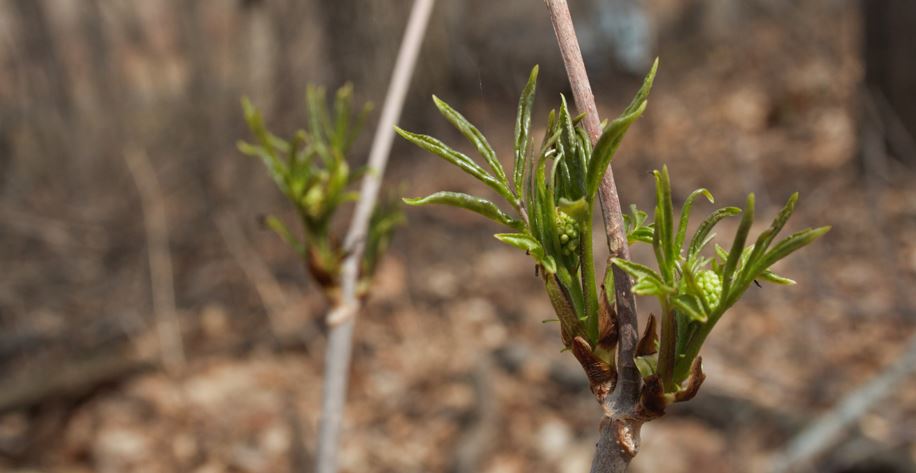
Bright green, young growth from buds of red elderberry.
Red elderberry, Sambucus racemosa, breaks it buds in early spring. Its phenology makes it a potential
competitor with common buckthorn, Rhamnus cathartica

One of the frustrations of removing common buckthorn (Rhamnus cathartica), is that it keeps coming back. Cut stems that aren’t treated with herbicide will sprout multiple shoots, and in areas where buckthorn has been removed, more sunlight is available to support the growth of sprouts and seedlings.

Controlling buckthorn then requires repeated visits to cut, re-treat or pull up the plants. Buckthorn seeds remain viable in the soil for up to five years, so several trips are necessary to remove seedlings and young plants. Even after the buckthorn seed bank is exhausted, nearby stands provide additional sources. Birds that eat the fruits can drop seeds into the treated area, turning buckthorn control into an ongoing project.


Dozens of buckthorn seedlings on a forest floor.
Buckthorn seedlings thrive where higher light intensity reaches the
forest floor.

Recognizing these challenges, scientists at the University of Minnesota are looking at a new way to manage this invasive plant. Instead of investigating mechanical or chemical controls, their research, called the Cover It Up study, asks whether native plants can thwart recolonization by exploiting buckthorn’s weakness: shade intolerance.

One of the plants in their study is red elderberry (Sambucus racemosa), a common understory shrub. Contrary to the perception that buckthorn leafs out earlier and retains leaves later than any native plant, elderberry is one of the earliest plants to resume growth in spring – even earlier than buckthorn. It also holds its leaves well into fall, rivaling buckthorn as the understory plant with the latest senescence.

That extended phenology suggests that both buckthorn and red elderberry are shade-avoidant, not shade tolerant. In fact, co-principal investigator Michael Schuster and his colleagues found that buckthorn growth is linked to light availability in spring and fall, but not in summer (1). Schuster and others also think that forests with a diverse understory can better resist invasion, because species with extended phenologies, like red elderberry, can block light from reaching buckthorn during those critical seasons (2).

Phase 2 of the Cover It Up study began in 2020. This expanded part of the research enrolled citizen scientists across Minnesota to remove buckthorn, establish experimental plots and sow seeds of native grasses, sedges, wildflowers, shrubs and trees. Their aim is to see what techniques can best prevent buckthorn recolonization in different parts of the state.

Phase 2 will conclude this year, and although it’s closed to new volunteers, anyone interested in following the research can subscribe to the quarterly project newsletter.

For more information about the Cover It Up study, including a list of species included in the Phase 2 seed mix, visit the project website at https://coveritup.umn.edu/. The seed list is under the Resources tab.

To learn how to identify buckthorn and how it harms ecosystems, visit these sites:


A January podcast from To Know the Land features Michael Schuster discussing the Cover It Up research.  To listen, click here.  

Finally, to learn how to identify red elderberry, see the Minnesota Wildflowers page for that species.


References

(1) Schuster MJ, Wragg PD, Williams LJ, Butler EE, Stefanski A, Reich PB. 2020. Phenology matters: Extended spring and autumn canopy cover increases biotic resistance of forests to invasion by common buckthorn (Rhamnus cathartica). Forest Ecology and Management 464. https://doi.org/10.1016/j.foreco.2020.118067.

(2) Schuster MJ, Wragg PD, Reich PB. 2021. Phenological niche overlap between invasive buckthorn (Rhamnus cathartica) and native woody species. Forest Ecology and Management 498. https://doi.org/10.1016/j.foreco.2021.119568.


Saturday, April 23, 2022

Plant Profile: Pasque Flower

Light purple Pasque Flowers blooming on a sunny day on the prairie.
Pasque Flower, Anemone patens, on April 19, 2022, at Crow Hassan Park Reserve. 


These Pasque Flowers were barely open on a cool April day, but as they expand, their bowl shapes will track the sun like tiny reflective dishes. The movement of the flowers, called heliotropism ("sun turning") keeps them warmer than their surroundings, providing an inviting place for pollinators to land.

Heliotropism is one of many adaptations Pasque Flower has to emerging and flowering early on the prairie, when conditions are unstable. Its spring phenology offers the benefit of less competition for water, light and pollinators, but it comes with the risk of late frosts and cold, windy weather that inhibits insect activity. 

Other adaptations include long hairs to blunt the effects of cold winds and chemical irritants that discourage herbivores from chomping on the first greens of the season. Crushed or chewed leaves contain protoanemonin, a molecule that irritates the digestive system. The same molecule can produce blistering rashes on the hands of wildflower-picking humans.

Where to Find Pasque Flower

Pasque Flower is a native perennial of dry prairies and open woods. It grows throughout much of Minnesota except for counties in the northeast. For a range map, see this Minnesota Wildflowers webpage

Pasque Flowers and Climate Change

Like other early spring perennials, Pasque Flower is especially sensitive to temperature, so this species is useful to observe for the effects of a warming climate. Around 2010, Elisabeth Beaubien and Andreas Hamann, two researchers studying the phenology of plants in the Central Parklands of Alberta, Canada, found that Pasque Flowers bloomed an average two weeks earlier than decades ago. The shift in phenology corresponded to increases in average temperature during the same period, 1936-2006. 

The two-week difference was greater than Beaubien and Hamann expected based on a thermal time model, a tool that predicts flowering time by adding accumulated degrees above a base value. They suspect increases in nighttime temperature are largely responsible for the shift. 

Their paper is here


Thursday, March 31, 2022

Flower Parts for Plant ID

White flower of large-flowered Trillium blooming on a forest floor.
Large-flowered Trillium, Trillium grandiflorum


Thanks to the four biomes that meet here, Minnesota hosts a diversity of plant life. According to the most recent MNTaxa plant checklist, the state is home to at least 2,250 species and varieties of vascular plants (1). Of those, about 94% are flowering plants, and most guidebooks focus mostly or entirely on that group. To help identify these plants, many wildflower guides rely on flower parts – their presence or absence, their number, their appearance –to arrive at a plant's name.

It’s useful, then, to know how flowers are put together. This post introduces basic flower structure, beginning with the names of flower parts and some common variations and then introducing some terms for flower clusters, called inflorescences. 

Flower parts

In a model flower, parts are organized in four whorls. From outermost to innermost, they are sepals, petals, stamens and one or more pistils. In some flowers, pistils are composed of joined parts, called carpels (seed leaves), to form a compound pistil. In others, the pistils are composed of only one carpel, so they’re called simple pistils. The diagram below shows a simple pistil.

Flower diagram showing sepals, petals, stamens and pistils.


All the sepals together form the calyx, from a Greek word describing a husk or a case for a bud. Many flower buds are enclosed in and protected by a calyx before they open. Similarly, all the petals together form the corolla, from a Latin word meaning wreath or crown.


Buds and pink flower of wild geranium showing calyx and corolla.


Each of the flowers below has all four parts. Sharp-lobed hepatica has flowers with multiple stamens, multiple simple pistils, five petals, and five sepals. Large-flowered trillium has three sepals, three petals, six stamens, and one compound pistil formed of three joined carpels. Three stigmas emerge from the top of the pistil.


Hepatica and large-flowered Trillium with four floral whorls.


The photo of wild geranium below shows two flowers in different stages of development. In the left flower, stamens are at peak maturity and are releasing pollen. The pistil in this flower is immature and hidden by the stamens. In the right flower, the stamens are past peak and are withering. The pistil, however, is in its prime, with five, curved stigmas ready to accept pollen.

Two pink wild geranium flowers at different stages of maturity.

Because the stamens and pistils mature at different times, the flower can’t pollinate itself. This difference in timing, called dichogamy (dy-COG-amee), favors cross-pollination and mixing of genes, creating more diverse -  and perhaps more successful – offspring. 

Tepals

Tepals are petals and sepals that look alike. They are especially common among plants in the lily family and its close relatives. Tulips and day lilies are two garden favorites that have tepals. Native white trout lily and blue-bead lily also have tepals.

Tepals of white trout lily and blue bead lily flowers.


Regular (actinomorphic) and irregular (zygomorphic) flowers

When viewed face on, regular flowers look like wheels or stars: Their parts are evenly distributed all the way around. More than one line can be drawn through the center of the flower to create similar halves. Such flowers are also called radially symmetric or actinomorphic, which means star-shaped.

In contrast, irregular flowers have only one plane of symmetry: Only one line can be drawn across their faces to produce similar halves. Irregular flowers are also called bilaterally symmetric or zygomorphic. “Zygo” is a Greek prefix meaning pair.

Regular flower of white avens and irregular flower of spotted jewelweed.


Complete and incomplete flowers

If flowers have all four parts – sepals, petals, stamens and pistils – they’re complete. If they’re missing one or more of these parts, they’re incomplete. Wild strawberry, for example, has complete flowers. The flowers of Canada anemone, however, have no petals and are incomplete. In that plant, sepals are the large, colorful parts that attract pollinators.

Flowers of wild strawberry and Canada anemone.


Perfect and imperfect flowers

These terms refer to the reproductive parts of a flower, the pistils and stamens. A perfect flower has both parts, whereas an imperfect flower has only one. A staminate flower has only stamens; a pistillate flower has only pistils.

If a species has imperfect flowers and the staminate and pistillate flowers are on the same plant, the species is monoecious (mon-EE-shus), meaning one house. If the species has staminate and pistillate flowers on different plants, it is dioecious (dy-EE-shus), meaning two houses. Sometimes dioecious plants are said to have separate “female” and “male” individuals.

Most flowers of silver maple, for example, are imperfect. Staminate and pistillate flowers are shown below. They may be on separate trees or on the same tree, so the plants can be dioecious or monoecious, respectively. Occasionally, a tree may also have perfect flowers.


Silver maple staminate and pistillate flowers.


Wind-pollinated flowers

Wind pollinated flowers don’t rely on insects to visit them, so they lack showy petals and sepals. Stamens and stigmas, however, are often numerous and obvious when the flowers mature. Silver maple, shown above, is wind pollinated, as are willows and aspens. Grasses are also wind pollinated. Two  prairie grasses, big bluestem and Indian grass, are shown below.

Protruding anthers and feathery stigmas of big bluestem and Indian grass.


Inflorescences

Some plants, like tulips or roses, produce flowers singly. Others produce flowers in clusters called inflorescences.

An aster, for example, isn’t one flower but many tiny ones, all clustered on a flat, rounded, or conical receptacle. The flowers in the center are called disk flowers. Those around the edge, often bearing petal-like rays, are called ray flowers. This arrangement, called a head inflorescence, is typical of plants in the aster or sunflower family.

Diagrams and photos of a head inflorescence and other common types are below. In the diagrams, black circles represent flowers. Different sizes of circles indicate that some flowers in an inflorescence mature sooner than others. The larger the circle, the earlier it opens. If all circles are the same size, they mature at the same time.


Head inflorescence of New England aster.


Spike of white prairie clover flowers and catkin of willow flowers.


Racemes of black cherry and Dutchman's breeches flowers.


Panicle of white flowers of false Solomon's seal.


Compound umbel of water hemlock flowers and fruits.


Compound corymb of yellow-green Norway maple flowers.


Cyme of St. John's wort.


Mixed inflorescences

Adding more challenge, some plants have mixed or combined types of inflorescences. Rough Blazing Star, for example, has heads arranged in a spike, and Showy Goldenrod has heads arranged in a panicle.

Spike of heads of rough blazing star and panicle of heads of showy goldenrod.


References

(1) MNTaxa: The State of Minnesota Vascular Plant Checklist. Minnesota Department of Natural Resources. Accessed March 30, 2022, online at https://www.dnr.state.mn.us/eco/mcbs/plant_lists.html.

(2) Minnesota Wildflowers: A field guide to the flora of Minnesota. Online at minnesotawildflowers.info.


Plant Profile: Common Elderberry

  Sambucus canadensis or Sambucus nigra subsp. canadensis Common elderberry growing on the edge of a cattail marsh. The largest inflorescenc...