Thursday, July 27, 2023

Plant profile: Jumpseed

Persicaria virginiana, formerly Polygonum virginianum, Antenoron virginianum, Tovara virginiana


Jumpseed, also called Virginia knotweed or woodland knotweed, is a perennial herbaceous plant native to the eastern U.S., including southeast and east central Minnesota. It thrives in the damp soils and part shade of deciduous woods and edges, often where there has been some disturbance. These plants were growing along a trail through a woodland.

From July into September, the plants produce long, slender racemes bearing tiny, whitish flowers, each just a few millimeters across when fully open. After pollination by honeybees, bumble bees, leaf-cutting bees, and other bees and wasps, the flowers form small fruits that are deflexed – they angle downward on their short pedicels (flower stalks), a tensioned position that needs only a slight touch to be released. When it is, the fruits “jump” off the plant. Their hooked ends, formed by remnants of their styles, can latch on to fur or clothing and help the seeds travel farther from their parents.

Jumpseed flowers in mid to late summer, producing slender racemes up to 16 inches (40 cm) long. The small flowers
have four sepals, but no petals. Fruits have hooked tips that can latch on to passing animals, including humans. 

Jumpseed also spreads by rhizomes, underground stems that form patches of plants. Where the plants aren’t desired, this can be a problem, because they tend to persist even after pulling. The same is true for eastern jumpseed, an introduced plant. Once considered a variety P. virginiana called filiformis but now recognized as a separate species, Persicaria filiformis, it is beginning to develop a reputation as invasive because of its rhizomatous habit. It differs from P. virginiana in having pink to red flowers and often variegated leaves, characteristics that make it popular in the horticultural trade. Several cultivars of eastern jumpseed, such as ‘Painter’s Palette,’ ‘Lance Corporal,' and ‘Batwings,’ are offered for sale from some nurseries.

The last two cultivar names come from colorations on jumpseed’s leaves. In spring, the leaves are marked with maroon or dark green chevrons, upside down V’s that resemble military insignia or wings. The chevrons on Virginia jumpseed disappear by the time the plants flower, but those on eastern jumpseed leaves may persist.


Jumpseed has alternate leaves and hairy ocreas.
Notice the swollen nodes. 
Jumpseeds belong to the buckwheat or knotweed family, Polygonaceae (poly-gon-AY-see-ee). A typical trait of the family is a thin sheath called an ocrea (or ochrea) above each node. In formal terms, the sheath is described as scarious, meaning it is dry and membranous. The ocrea is formed from stipules that, sometime in the long history of knotweeds, fused to form a tube around the stem. 

Another trait that identifies this family is its knobby or swollen nodes. They resemble knees, if you use your imagination. Polygonaceae means “many knees.”


References


Maryland Invasive Species Council (Persicaria filiformis)

John Philip Baumgardt. How to Identify Flowering Plant Families: A Practical Guide for Horticulturists and Plant Lovers. Timber Press, 1982. 


Tuesday, July 18, 2023

Plant Profile: Michigan Lily


Michigan lily flowering in mid-July in Hennepin County, Minnesota.


This lone Michigan lily (Lilium michiganense), barely out of reach of the ditch mower and surrounded by invasive reed canary grass (Phalaris arundinacea), grows at the edge of a wetland. That’s typical for this native perennial, which is also found along streambanks and shores and in wet meadows, prairies, bogs and woodland edges and openings.

Michigan lily looks much like Turk’s cap lily (Lilium superbum), another native that grows in the same habitats farther south. In fact, some references call Lilium michiganense Turk’s cap lily, a mix-up that shows why scientific names are helpful. They may be tongue-twisters, but unlike common names, scientific names are usually the same no matter where you are (or what you’re reading), so there’s less confusion.

According to most references, this one is almost certainly Michigan lily. It’s 34 feet tall, well within the 3 to 6foot height typical of this species. Turk’s cap lily tends to grow taller, usually 57 feet.

Their flowers also differ, but the differences are subtle. Both species have umbels of nodding flowers with orange-red, dark-spotted tepals (similar petals and sepals) that are reflexed, bending back toward the base of the flower. Large stamens and a long pistil emerge from the center of the flowers and hang downward.

Umbels of Michigan lily flowers (left) and sets of whorled leaves on the stem (right).


In Michigan lilies the tips of the tepals are said to reach the base of the flower, but not much farther. In contrast, the tepals of Turk’s cap lily reach so far back they go beyond the base of the flower and may touch each other. In addition, their anthers, the pollen-bearing tips of the stamens, differ in length. According to several references, those of Michigan lily are never more than ½ inch long, whereas those of Turk’s cap lily are at least ½ inch long or longer.

If you don’t have a ruler handy, there are other differences to look for. If flower buds are present, look at their shapes. Michigan lily buds are more or less round in cross section, whereas Turk's cap lily buds are triangular. Open flowers also display differences. The pistil of Michigan lily is orange-red, whereas the pistil of Turk’s cap lily is greenish white to whitish orange. Looking deep into the flower, you’ll sometimes see a green, star-shaped center in Turk’s cap lily, but not in Michigan lily. 

Another look-alike is the introduced tiger lily, Lilium lancifolium, a garden favorite. It differs from both Michigan and Turk’s cap lilies in that it has alternate, not whorled, leaves, and small bulbs in the leaf axils.

Growing near this Michigan lily was yet another look-alike, Tawny day lily, Hemerocallis fulva. Also called ditch lily for its common habitat, it has orange-red flowers that open upward and have streaked but not spotted tepals. Day lilies have strap-shaped basal leaves but no leafy stems.

Tawny day lily flowers on leafless stems amid strap-shaped basal leaves. The flowers open upward, their red-orange tepals streaked but not spotted.


Michigan lily ranges throughout the upper Midwest and the Great Lakes region and less commonly farther east and south. In this region, it flowers in July. Pollinators are thought to be hummingbirds, butterflies and moths.

Michigan lily's range in North America (left) and the Upper Midwest (right). Maps from USDA Plants Database.


References


Sunday, June 25, 2023

Plant profile: Cow parsnip

Caution: The sap of cow parsnip and other members of the carrot family can cause skin rashes and blisters. See below for more information.

Cow parsnip, Heracleum maximum, is a big plant with a big name. This 4- to 8-foot-tall native plant of damp meadows and fields, streamsides, ditches, and low, open woods is named for Heracles or Hercules, the mythic Greek hero of superhuman strength. Even the species name, maximum, hints at its size. Few herbaceous plants are as robust.

A biennial or short-lived perennial in the carrot family, cow parsnip has alternate, divided leaves up to 2 feet across, with smaller, undivided leaves higher on the stem. The leaflets are irregularly lobed, coarsely toothed, and hairy. The petioles of lower and middle leaves are 3 to 10 inches long with sheaths where they meet the stem. Stems are stout, hollow, ridged, and hairy.

Lower leaves of cow parsnip are divided into three lobed, toothed leaflets. This leaf blade (left) is about 18 inches long. Petioles are long with sheaths where they meet the stem (right).


Cow parsnip flowers from late May into early July. Small, white, 5-petaled flowers are in flat-topped, compound umbels, clusters that resemble a collection of little umbrellas. (See Flower Parts for Plant ID to learn more about types of flowers and flower clusters, called inflorescences.) The flowers are pollinated by honeybees and many kinds of native bees and flies, the variety so great that some consider cow parsnip a pollinator magnet.

Cow parsnip flowers are arranged in compound umbels. Each spoke of the umbel extends to another, smaller umbel, called an umbellet. The tiny, white flowers have five petals. 


Fruits are flattened, up to 1/3 inch long and 1/4 inch wide, and brown with dark, vertical lines when they mature in late summer or early fall. They are winged on their edges and so can be dispersed a limited distance by wind. Eventually the fruits split apart and release two seeds. Cow parsnip reproduces only by seed.

These immature fruits of cow parsnip will turn brown when they mature in late summer.

Although the plant is native here and in much of North America, in some states it’s introduced and invasive. In North Carolina, for example, cow parsnip is described as aggressive and insidious and is classified as a noxious weed.

Be Careful

Cow parsnip is rarely considered an ecological problem here, but it should be handled with care. The leaves and stems contain furanocoumarins, compounds that sensitize skin to ultraviolet light. If skin is exposed to plant sap and then sunlight, blistering rashes may result. The condition, called phytophotodermatitis, can take weeks to heal. Always wear gloves, long sleeves and pants when handling this plant, and wash off and cover skin if exposed to the sap. The sap can also damage the eyes, so it’s best to wear eye protection if the plant will be disturbed.

Watch Out for a Look-alike

Giant hogweed (Heracleum mantegazzianum), a similar but much larger plant, is introduced and invasive. So far, this 10- to 15-foot-tall plant hasn’t been found in Minnesota, but it is present in Wisconsin, and it’s known to be especially hazardous. The Minnesota Department of Agriculture includes giant hogweed on its list of noxious weeds that should be eradicated if found. Report the plant’s location using Report a Pest or EDDMapS and handle it using extreme caution.

Invasive Plants in the Carrot Family

Cow parsnip isn’t one of Minnesota’s “bad carrots,” but several other species are, including not only giant hogweed but also wild parsnip, burnet saxifrage, Queen Anne’s lace, and several others. A guide to identifying these plants is available in the Downloads tab.


References

Friends of Eloise Butler Wildflower Garden

Minnesota Wildflowers

BWSR Featured Plant: Cow Parsnip

Illinois Wildflowers

USDA, NRCS. 2023. The PLANTS Database (http://plants.usda.gov, 06/21/2023). National Plant Data Team, Greensboro, NC USA.

Giant hogweed – Minnesota Department of Agriculture

Giant hogweed (Heracleum mantegazzianum) – Minnesota Department of Natural Resources


Friday, June 9, 2023

Plant Profile: Starflower

Starflower blooming in late May in a mixed coniferous-deciduous forest in north-central Minnesota.


Starflower (Trientalis borealis, aka Lysimachia borealis) is a spring-blooming, perennial wildflower of coniferous and deciduous forests. In early spring, stems emerge from overwintering tubers and grow 4–8 inches tall, their slender stems bearing six to eight lance-shaped leaves of unequal size. In May and June, one, two, or rarely three flowers grow from the leaf axils. Each flower is about ½ inch wide and typically has seven white, pointed petals and orange anthers that later turn brown.

The flowers are self-incompatible, so they can’t pollinate themselves. To form seeds, they must receive pollen from another patch of starflowers, delivered primarily by native mining bees (andrenid bees), sweat bees (halictid bees) and hover flies (syrphid flies). If the bees are present, if the patches are close enough for the bees to transit, and if pollination is successful, small seed capsules eventually form at the tips of the stems.

That’s a lot of ifs and little assurance of a next generation. Starflower doesn’t depend only on seeds for reproduction, however. In fact, very little of its energy is dedicated to flowering and seed set. Most of its reproductive effort is spent on rhizomes, underground stems that extend the plant’s reach and give rise to new plants. It’s a faster way of reproducing, and in a stable environment, it’s more reliable. The downside is that the parent plant and its vegetative offspring are genetically identical, so if the environment changes, the plants may not have what it takes for a population to survive.

If conditions remain favorable, though, the rhizomes grow and form patches of new plants. By midsummer, tubers begin forming at their tips. Aided by the cool nights of late summer and fall, they fill with starch to fuel next year’s growth. Rhizome connections then wither and the leaves yellow and fall. Bare stems topped with capsules are all that remain above ground, while tubers below ground carry their incipient roots and shoots through winter, ready to resume growth in spring. Starflower seeds also overwinter, but they don’t germinate until fall of the second year.

Starflower range in North America (left ) and the Upper Midwest (right). Maps from USDA Plants Database.


As with many plants, Starflower is facing challenges brought by climate change. The cool nights needed for maximum tuber development are warmer now, and researchers have found that flowering and seed set lessen toward the southern edge of the plant’s range. These changes raise questions and concerns about whether the species can adapt, because in some places, it isn't. Starflower is state-listed as endangered in Georgia and state-listed as threatened in Illinois.

Populations in Minnesota and other northern locations are responding to warmer May temperatures by flowering earlier. That may or may not be beneficial, but so far, starflower seems to be holding its own here. The species name borealis, meaning “of the north,” may be truer than ever.

References

Minnesota Wildflowers

Illinois Wildflowers

USDA, NRCS. 2023. The PLANTS Database (http://plants.usda.gov, 06/03/2023). National Plant Data Team, Greensboro, NC USA.

Roger C. Anderson. June 1970. The role of daylength and temperature in tuber formation and rhizome growth of Trientalis borealis Raf. Botanical Gazette, Volume 131, Number 2, pp. 122-128.

Roger C. Anderson and Orie L. Loucks. July 1973. Aspects of the biology of Trientalis borealis Raf. Ecology, Volume 54, Issue 4, pp. 798-808.

Roger C. Anderson and Michael H. Beare. March 1983. Breeding system and pollination ecology of Trientalis borealis (Primulaceae). American Journal of Botany, Volume 70, Issue 3, pp. 408-415.

Emily Dangremond. No date. Climate change and starflower in the Midwest. Illinois Native Plant Society.

Emily Dangremond, Christopher H. Hill, Shahd Louaibi, and Ivette Muñoz. 2021. Phenological responsiveness and fecundity decline near the southern range limit of Trientalis borealis (Primulaceae). Plant Ecology, Volume 223, pp. 41-51.  

Linda G. Chafin. 2020. Trientalis borealis Raf. Georgia Biodiversity Portal, Georgia Department of Natural Resources/Wildlife Resources Division.


Wednesday, April 12, 2023

What Are Catkins -- and Why Does "Gesundheit" Come to Mind?

A branch of quaking aspen with several clusters of hanging, cylindrical, fuzzy catkins.
Catkins of quaking aspen, Populus tremuloides, began emerging in March in southern Minnesota. This photo was taken in mid-April.


Catkins, also called aments, are cylindrical, sometimes pendant clusters of inconspicuous flowers. They are typical of willows, aspens, poplars, birches, alders, hazelnuts and ironwood trees and shrubs. All these plants bloom in spring, often before leaves emerge, and most are wind pollinated. Willows are also insect pollinated and can be an important source of pollen and nectar for early-emerging insects, including those that later pollinate crops (1).

Catkins contain either male (pollen producing) or female (seed producing) flowers on the same or different plants. Ironwood (Ostrya virginiana), hazelnuts (Corylus spp.), birches (Betula spp.) and alders (Alnus spp.) have male and female catkins on the same plants, so they’re said to be monoecious (mon-EE-shus), which means “one house.”

In contrast, aspens and poplars (Populus spp.) have male and female catkins on different plants, so they’re dioecious (di-EE-shus), meaning “two houses.” Willows (Salix spp.) are also dioecious.

The emergence of catkins and the release of pollen marks not only the beginning of spring but also the start of allergy season. Wind-pollinated plants tend to produce abundant pollen because the grains could land anywhere – perhaps on a female flower of the same species, but maybe on those of a different species or even on no plant at all. Such as on you.  

Flurries of pollen may add to the misery for allergy sufferers, but for aspens, willows, and similar plants, they’re an insurance policy. The possibility of a next generation literally blows in the wind, so the more pollen, the better. "Gesundheit" for one, then, is good fortune for the other. 

Reference

1) Ostaff, D. P., Mosseler, A., Johns, R. C., Javorek, S., Klymko, J. and Ascher, J. S. 2015. Willows (Salix spp.) as pollen and nectar sources for sustaining fruit and berry pollinating insects. Can. J. Plant Sci. 95: 505[1]516. DOI:10.4141/CJPS-2014-339.


Thursday, March 23, 2023

New Invasive Plants to Watch For

The Minnesota Department of Agriculture has added several new plants to its 2023 noxious weed list. This post focuses primarily on additions to the Prohibited-Eradicate category, but three other categories – Prohibited-Control, Restricted and Specially Regulated – are covered at the end of the post.

Prohibited-Eradicate: The Early-Detection List

The plants in this group either aren’t here yet or are present in low numbers. They're in the early-detection stage, when ideally, they can be found and removed before they become widespread. As the name of the group suggests, these plants should be eradicated by destroying all above- and below-ground parts. Transporting, propagating or selling them is illegal.

Three plants are new to the list this year: Johnsongrass, pale swallow-wort and red hailstone.

Johnsongrass
Sorghum halepense

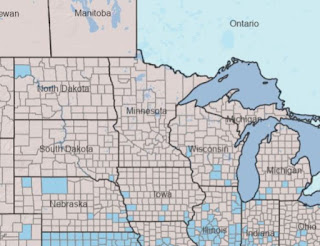
Distribution map of Johnsongrass in the Upper Midwest. So far, no counties in Minnesota are highlighted.
USDA NRCS Plants Database (see references). Johnsongrass is
confirmed in counties shaded blue. Lakes and rivers are also
shaded blue.
This perennial grass was introduced to the U.S. in the 1800s as a forage crop. It is now found in many
habitats, including pastures, roadsides, ditches, old fields and wetlands. It reproduces by seeds and rhizomes and can spread aggressively to form dense mats that exclude other plants. It will not tolerate drought or extreme cold, so where winters are severe, Johnsongrass may be a facultative (optional) annual. Stressed plants can produce toxic levels of cyanide.

Johnsongrass grows 8-12 feet tall when flowering. Leaves are alternate, hairless and up to 2 feet long with white midribs. Ligules are 3-4 mm long, membranous and sometimes toothed. Johnsongrass flowers from mid-summer to fall in loose, purplish panicles.

Leaves of Amur silvergrass (Miscanthus sacchariflorus), another introduced plant, also have white midribs, but this plant is shorter at 6-8 feet. Its ligules are a hairy fringe, and its panicles are silvery and silky in fall.
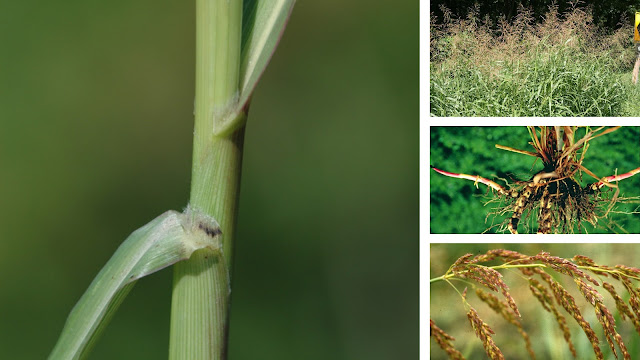
Panel of photos showing features of Johnsongrass for identification.
Clockwise from left: Johnsongrass stem and dense stand by Chris Evans, University of Illinois, Bugwood.org; Johnsongrass rhizomes and panicle by Steve Dewey, Utah State University, Bugwood,org. 


Pale swallow-wort
Cynanchum rossicum (aka Vincetoxicum rossicum)
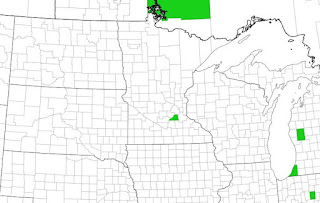
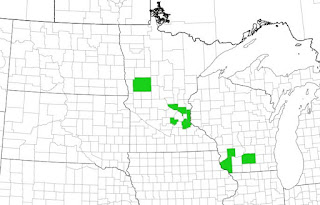
Distribution map of pale swallow wort in the Upper Midwest. So far, only one metropolitan-area county is highlighted.
EDDMapS (see references). Pale swallow-wort is confirmed in
counties shaded green.The plant has also been confirmed in Ontario.
Pale swallow-wort, also called European swallow-wort, is a perennial, twining vine that was imported
to the U.S. in the late 1800s, probably as an ornamental. It thrives in disturbed sites but can grow in a variety of habitats, including fields, pastures and woodland edges and understories. Fast-growing and shade tolerant, it can quickly overrun and outcompete other plants. Because swallow-wort is in the milkweed family, female monarchs will sometimes lay their eggs on it if common milkweed is unavailable. There is concern, however, that swallow-wort is toxic to monarch larvae.

The vine has opposite, shiny, oval or heart-shaped leaves with pointed tips. Stems grow to 7 feet long, wrapping around other plants or structures for support or clambering over the ground. Sap is clear, not white. Clusters of pink to reddish-brown, star-shaped flowers bloom in June and July. Pods are slender, smooth and 2-3 inches long.

Black swallow-wort (Cynanchum nigrum) is also on the Prohibited-Eradicate list. It looks like pale swallow-wort but has dark purple flowers.
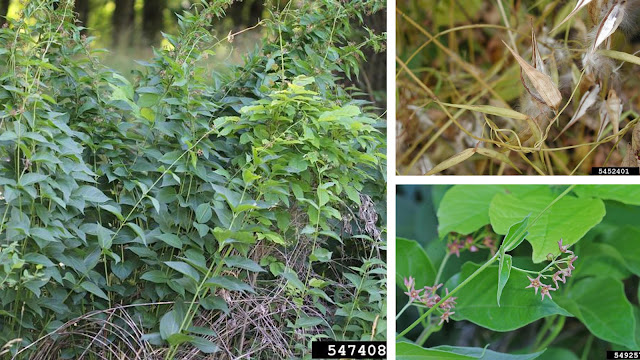
Panel of photos showing features of pale swallow wort for identification.
Clockwise from left: Pale swallow-wort vines by Rob Routledge, Sault College, Bugwood.org; Pods and seeds by Leslie J. Mehrhoff, University of Connecticut, Bugwood.org. Leaves and flowers by Rob Routledge, Sault College, Bugwood.org.


Red hailstone
Thladiantha dubia

Distribution map of red hailstone in the Upper Midwest. Scattered counties in Minnesota are highlighted.
EDDMapS (see references). Red hailstone is confirmed in 
counties shaded green. 
Also called golden creeper or tuber gourd, red hailstone is a perennial vine introduced to North America
in the late 1800s or early 1900s as an ornamental. This adaptable plant grows in abandoned fields, roadsides, gardens, crop fields, railroad corridors and natural areas. Red hailstone can quickly overgrow and smother other plants, including crops.

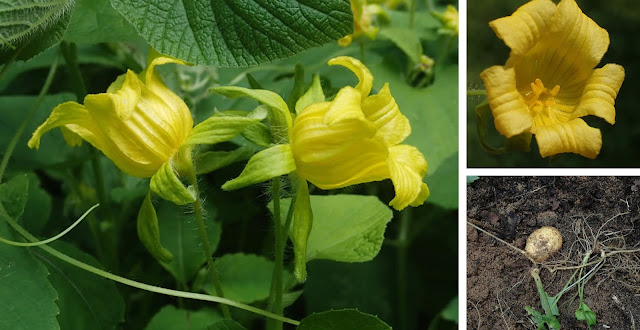
Vines grow up to 20 feet long with tendrils that grasp other plants or structures for support. Leaves are alternate and heart-shaped. Stems, leaves and petioles (leaf stalks) are hairy. Yellow, tubular flowers bloom from July to September on separate male (pollen-producing) and female (seed-producing) plants.

So far, all plants found in Minnesota are male, so the vines aren’t spreading by seed. Instead, they reproduce vegetatively by small tubers carried along waterways; many of the mapped infestations are along rivers or streams. Where both male and female plants grow, 2-inch oblong fruits may form on female vines. The fruits turn red when mature, thus the name red hailstone.

Before it flowers, red hailstone resembles other tendril-bearing vines in the same family. Wild cucumber (Echinocystis lobata) is a hairless vine with five-lobed leaves and white flowers that bloom in late summer. Bur cucumber (Sicyos angulatus) is hairy but also has five-lobed leaves. Its flowers are white or greenish-white. Neither cucumber vine has red fruits.

Clockwise from left: Red hailstone leaves and infestation by Katy Chayka, Minnesota Wildflowers; Red hailstone flowering plants by Peter Dzuik, Minnesota Wildflowers.


Clockwise from left: Red hailstone flowers by Peter Dzuik, Minnesota Wildflowers; male flower closeup by Katy Chayka, Minnesota Wildflowers; rhizomes and tuber by Katy Chayka, Minnesota Wildflowers.


Other Categories of Noxious Weeds

The MDA defines three other categories of noxious weeds. Two were expanded in 2023.

·         Prohibited-Control: Plants in this category are already established here, so eradication isn’t practical. Management aims at preventing them from reproducing by seed or vegetative organs, such as rhizomes, tubers or stem fragments that can take root. Transportation of all propagating parts is illegal except as allowed by state law, and the plants may not be propagated or sold in the state. Sixteen species are on the list, including three kinds of knotweed featured in a previous post, Are Psyllids the Solution to Invasive Knotweeds? No new species were added in 2023. 

·        Restricted: These plants are widespread in Minnesota. The only practical way to manage them is to restrict their importation, sale and transportation in the state, except as allowed by state law. Two plants are new to the list this year: lesser celandine (Ficaria verna), an aggressive spring ephemeral and garden escapee, and salt cedar (Tamarix ramosissima), also called tamarisk, a shrub first introduced in the West for landscape use, windbreaks and erosion control. 

·        Specially Regulated: These are native or nonnative weeds that are economically valuable but potentially harmful if not controlled. Three plants are new to the list this year. Amur corktree (Phellodendron amurense) now must be removed wherever females have been planted or escaped, or their fruits and seeds must be prevented from spreading. Only male cultivars are legal to sell. Production of Callery pear (Pyrus calleryana) is being phased out over the next three years, after which the tree will be moved to the Restricted category. Tatarian maple (Acer tataricum) and its cultivars can be sold only if a label is attached advising that they should be planted only where the seedlings can be controlled, and ideally at least 100 yards away from any natural area.


References

EDDMapS. 2023. Early Detection & Distribution Mapping System. The University of Georgia - Center for Invasive Species and Ecosystem Health. Available online at http://www.eddmaps.org/; last accessed March 20, 2023.

USDA, NRCS. 2023. The PLANTS Database (http://plants.usda.gov, 03/23/2023). National Plant Data Team, Greensboro, NC USA.

Johnsongrass

Wisconsin Department of Natural Resources

Minnesota Department of Agriculture

USDA Fire Effects Information System

University of Missouri


Pale swallow-wort

Minnesota Department of Agriculture

USDA Forest Service

Wisconsin Department of Natural Resources

Michigan Department of Natural Resources


Red hailstone

Minnesota Department of Agriculture

University of Minnesota Extension Service

Minnesota Wildflowers


Tuesday, March 7, 2023

The Boon of Biological Nitrogen Fixation

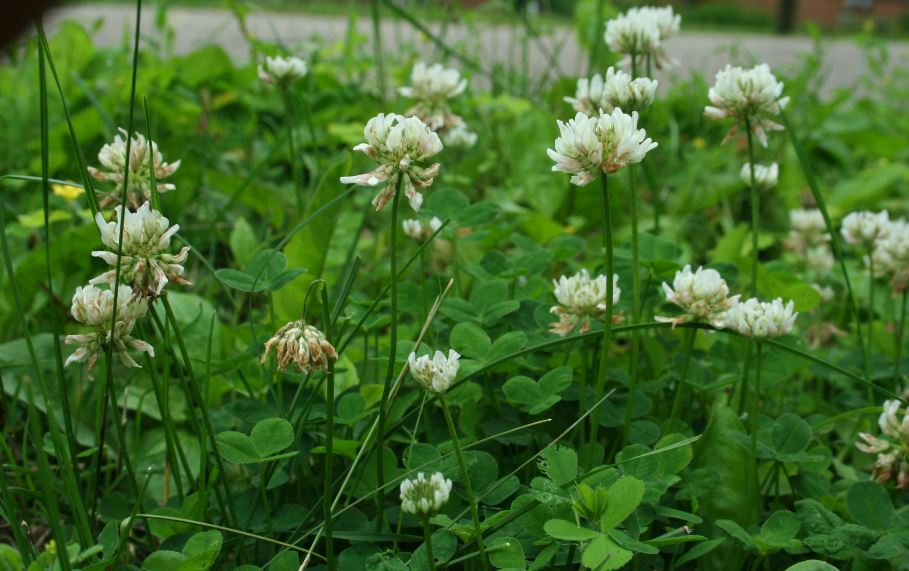
A patch of white clover in bloom.
White Clover, Trifolium repens.


White Clover is so common and modest that it’s often ignored. It’s like background noise: always there but barely noticed, at least until it flowers. Beneath its ordinary appearance, though, is an extraordinary ability: It can capture atmospheric nitrogen, N2, and convert it to ammonia, NH3, a first step in making nitrogen usable.

Called biological nitrogen fixation, this process is billions of years old and vital to life as we know it. Although nitrogen gas composes about 78% of the atmosphere by volume, most living things can’t use it. We humans, for example, can’t simply take a deep breath and get the nitrogen we need. We don’t have the molecular machinery to do that.

But some kinds of bacteria do. They possess nitrogenase, a complex enzyme that can break the strong bonds in nitrogen molecules and attach the atoms to hydrogen, making ammonia. Ammonia then goes on to participate in other reactions that make proteins, DNA and other biomolecules. When these compounds decay, or when some of the captured nitrogen leaks into the soil, other plants absorb it. We eat these plants or the animals that graze on them to get our supply of nitrogen. We can’t live without it.

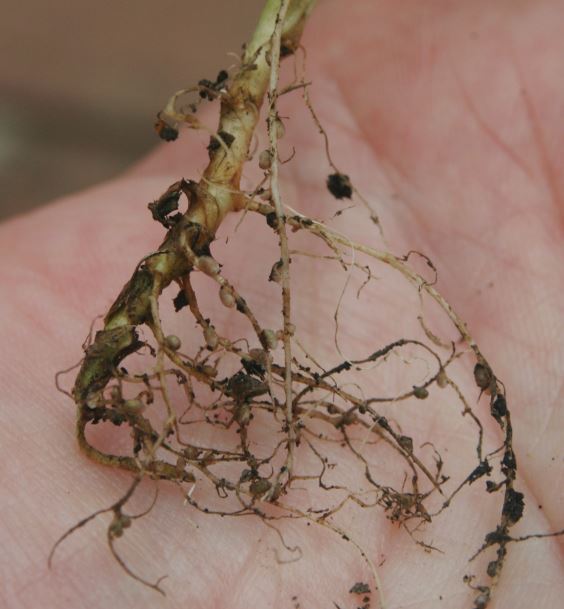
Clover and other legumes house nitrogen-fixing bacteria in nodules on their roots. This symbiosis is of mutual benefit: The plants receive nitrogen from the bacteria, and the bacteria receive energy and carbon compounds from the plants. The nodules also provide a low-oxygen environment for nitrogenase to work. A kind of hemoglobin called leghemoglobin scavenges oxygen that would otherwise disable the enzyme. At the same time, leghemoglobin provides oxygen for cell respiration, the set of reactions that produces the energy to drive nitrogen fixation and other processes.

The exposed roots of white clover showing many small nodules attached.
Nodules on the roots of White Clover hold bacteria that fix    
nitrogen.


Legumes are the primary biological nitrogen fixers, but a few plants in other families can do the same. Speckled Alder (Alnus incana), Silver Buffaloberry (Shepherdia argentea) and New Jersey Tea (Ceanothus americanus), for example, are non-legumes that also house nitrogen-fixing bacteria in root nodules. Called actinorhizal plants, they are mostly trees and shrubs from temperate regions. They are adapted to nutrient-poor soils, so some of them have been used to restore land degraded by mining, logging, wildfires or other disturbances.

Other fixers live freely in soil, or they live in close association with roots but not inside nodules. The latter includes bacteria that live in the rhizosphere (the near-root environment) of many grasses, including wheat and corn. Some researchers are trying to develop nodulating cereal crops that capture more of the nitrogen they need naturally instead of absorbing it from manufactured, energy-intensive fertilizer, which now supplies most of the nitrogen needed for agriculture. If they succeed, it could be part of the answer to mitigating climate change – and to feeding a hungry world.

Sources

Wagner, S. C. (2011) Biological Nitrogen Fixation. Nature Education Knowledge 3(10):15

Bernhard, A. (2010) The Nitrogen Cycle: Processes, Players, and Human Impact. Nature Education Knowledge 3(10):25

Diagne, N., Arumugam, K., Ngom, M., Nambiar-Veetil, M., Franche, C., Narayanan, K. K., & Laplaze, L. (2013). Use of Frankia and actinorhizal plants for degraded lands reclamation. BioMed Research International, 2013, 948258. https://doi.org/10.1155/2013/948258

Bakum, J. (2022) Biological nitrogen fixation and prospects for ecological intensification in cereal-based cropping systems. International Maize and Wheat Improvement Center (CIMMYT). 

Plant Profile: Common Elderberry

  Sambucus canadensis or Sambucus nigra subsp. canadensis Common elderberry growing on the edge of a cattail marsh. The largest inflorescenc...