Showing posts with label Identification Tips. Show all posts

Thursday, November 9, 2023

Moonseed Vine: A Poisonous Grapevine Look-Alike

Moonseed vines with twining stems and fading leaves.
Moonseed vine, Menispermum canadense, in early fall. Although most of its leaves have now fallen, it can still be identified -- and avoided, if foraging.

Moonseed vine (Menispermum canadense), also called Canada moonseed, is a twining vine of deciduous forests and riverbanks, thriving in moist or mesic soils and partial shade. Although the vines have now shed their leaves, moonseed vine can still be identified by other characteristics, and for foragers of wild foods, the distinctions could be lifesaving.

The danger comes from mistaking moonseed vine for riverbank grape (Vitis riparia). Both vines produce clusters of deep blue or purple, spherical fruits that can remain on the vines through winter. Unlike edible grapes, however, moonseed fruits are poisonous.

That’s because moonseed vine contains alkaloids, compounds many plants produce for defense against herbivores. Although alkaloids have been and are used medicinally, they can also be poisonous. Several sources report that eating moonseed vine, especially the fruits and seeds, can be fatal because of its alkaloids. The Minnesota Poison Control System includes moonseed on its list of toxic plants and advises calling Poison Control if any part of the plant is eaten.

Fortunately, poisoning can be avoided. There are reliable ways to tell the difference between moonseed and riverbank grape, even in fall and winter. Here’s what to look for.

Seeds
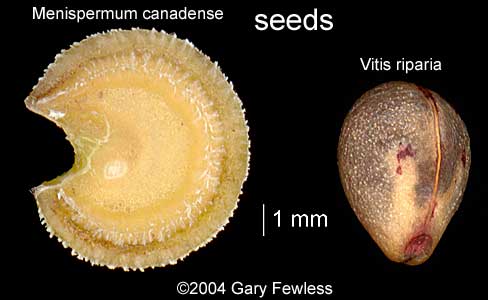
Mash fruits and crescent seeds of moonseed vine.

Moonseed fruits contain single, flat seeds that look like crescent moons. In contrast, riverbank grape seeds are egg-shaped, and there are usually several inside each fruit. This photo from the University of Wisconsin shows them side by side. 

Twining vs. grasping vines

Moonseed is a twining vine. It clambers over other vegetation or climbs upward by wrapping its stems around small trees or shrubs. Riverbank grape is a grasping vine. It uses tendrils, modified leaves, to clutch onto supports and hold the vines upright. 

A panel of two photos showing moonseed vines with twining stems and grapevine stems with coiled, grasping tendrils.
Twining stems of moonseed vine, left, and grasping stems of riverbank grape, right.

Stems and bark

The young stems of moonseed vine are brown or greenish brown and hairy, although as the stems age, they lose the hairs. Stems grow as large as 2 cm in diameter ( a little less than an inch) and have ridged or fluted bark. 

Younger stems of grapevine are brown or reddish brown and hairless. Mature stems grow up to 20 cm in diameter (about 8 inches) and have brown, shaggy bark.

Young moonseed stems, left, are brown or brownish green and hairy. Young stems of riverbank grape, center, are reddish brown and smooth. Mature stems of riverbank grape, right, are brown and shaggy. 

Leaf scars and buds

Leaf scars are marks on woody stems left by petioles when leaves are shed in fall. Inside them are small, often raised dots called bundle scars, created when strands of vascular cells (water- and food-conducting cells) are severed when leaves fall off the stem. Buds – next year’s protected growth – sit above the leaf scars.

The leaf scars of moonseed vine are typically 2-3 mm long and wide, oval to circular in outline, and concave. They are often notched or split at the top. Inside the leaf scar, the bundle scars are arranged in a faint, broken circle or oval. The bud is barely visible above the leaf scar; it appears to be embedded in the stem, protruding a millimeter or less above the surrounding tissue.

Leaf scar and bud of moonseed vine viewed from the front (left) and side (right). 

The leaf scars of riverbank grape are typically 2-4 mm long and wide and roughly triangular, semicircular, or U-shaped. The perimeter of the leaf scar may be ridged, but the leaf scar is not noticeably concave. To the side of the leaf scars are linear marks called stipule scars.(Stipules are thread-like or leafy structures at the bases of petioles in some plants.) Bundle scars are hard to see, but there are several. The bud is brown or reddish brown and 3-5 mm long. 

Leaf scar, bud and stipule scar of riverbank grape viewed from the front (left) and side (right).

Leaves, if still present

Both moonseed vine and riverbank grape have alternate, lobed leaves, but they have different margins (edges) and points of petiole attachment. These features can also be found on fallen leaves if they’re still intact.

The margins of moonseed leaves are smooth, although the lobes may have pointed tips. In addition, the petioles are attached inside the leaf blade, even if just barely, making a peltate or shield-shaped leaf blade. The leaves of riverbank grape are sharply and coarsely toothed, and the petiole is attached at the edge of the blade, at its base. 

Riverbank grape, left, has lobed, coarsely toothed leaves. Moonseed vine (right) also has
lobed leaves, but the margins are smooth, not toothed.

The petiole of riverbank grape, left, is attached at the edge of the blade. The petiole of
moonseed vine, right, is attached just inside the blade. 

Rhizomes and roots

Although aboveground characteristics are enough to positively identify moonseed and grapevine, belowground structures can also be helpful if it's possible -- and permissible -- to uncover or uproot them.

Moonseed vines have yellow rhizomes, underground stems that grow horizontally and produce roots and shoots along their length. Because of their color and traditional use to treat various ailments, Dakota Indians call it yellow medicine, the namesake of Yellow Medicine River and Yellow Medicine County in southwest Minnesota. The homeland of the Dakota is Pezihutazizi Kapi, “the place where we dig for yellow medicine.”

No source for this article describes grapevine as having rhizomes, but its woody, brown stems can become buried and grow roots at their nodes. These rhizome-like stems look nothing like the slender, yellow rhizomes of moonseed vine, however. 

The rhizomes of moonseed vine, left, are yellow. The roots and rhizome-like stems of riverbank grape, right, are brown.

Moonseed vine is found in much of Minnesota but is more abundant in the southern part of the state. Its broader range generally covers the eastern half of the US. The vine flowers in late spring and early summer. For more information, see the webpages from Minnesota Wildflowers and The Friends of the Wildflower Garden, Inc. Both are linked below.

Range maps of moonseed vine, from the USDA Plants Database.

Riverbank grape is also found in most of Minnesota except for several counties in the far north and northeast. More broadly, its range extends from the Mid-Atlantic states into New England and west through the Dakotas.

References

Wednesday, October 11, 2023

Flinging Spores and Fern ID

Sori on the back of a lady fern frond. Dozens of brown sporangia emerge from beneath the edge of a nearly translucent indusium.

The back of this lady fern frond (Athyrium filix-femina) is covered with sori, clusters of spore-forming bodies called sporangia. Each sorus holds dozens of them, all covered by a protective flap of tissue called an indusium. When a sporangium matures and dries, a line of cells over the top of the sporangium contracts, causing it to fling open and catapult its spores. You can watch it happen here in a sorus of an unidentified fern.

A spore print made by a lady fern frond. The spores are so small they look like dust. 

Unlike seeds, spores don’t contain embryonic plants. They’re little more than tiny packages of DNA that give rise to the next generation of ferns. They do this by first growing a small, heart-shaped prothallus, a body that produces egg and sperm cells. The flagellated sperm cells swim through a film of water to fertilize the egg cells, which then grow into the ferns we recognize. Because water is needed for this kind of reproduction, many ferns rely on damp or humid habitats.

A closeup of the back of a lady fern frond with a labeled sorus, sporangia and indusium.
Lady fern is identified in part by the shape of its sori. They are usually curved or
horseshoe-shaped. They appear in late summer and early fall.

A cluster of brown fertile fronds of ostrich fern. Their shapes resemble ostrich feathers.
Fertile fronds of ostrich fern.
Not all ferns have sori that look like those of lady fern. Some are located along the edges of the frond, some have indusia of different shapes or sizes, and some have no indusia at all. Other ferns, such as ostrich fern (Matteuccia struthiopteris) and sensitive fern (Onoclea sensibilis), produce spores on fronds specialized for that purpose – in other words, the whole frond is devoted to forming spores. For all these variations, timing is important. Sori and reproductive fronds (aka fertile fronds) may appear only at certain times of the year, and the appearance of sporangia and sori can vary depending on how old they are. 


Both reproductive and vegetative characteristics are helpful to identify a fern. Here are some resources to learn more about fern anatomy, biology and identification.

  • Ferns. U.S. Forest Service. This site may take a few tries to load.
  • Dichotomous Key to Ferns of Wisconsin, by Tim Gerber, UW-La Crosse.
  • Key to Fern Traits, by Areca Treon. This is a key to ferns in Cedar Creek Ecosystem Science Reserve near Bethel, MN.
  • Ferns of Minnesota, by Rolla Tryon. Illustrated by Wilma Monserud. University of Minnesota Press, 1980. ISBN 0-8166-0932-2.
  • Ferns and Lycophytes of Minnesota: The Complete Guide to Species Identification, by Welby R. Smith (author) and Richard Haug (photographer). University of Minnesota Press, 2023. ISBN 1517914663.

 For more information about lady fern, try these sites:

Friday, January 6, 2023

What Is a False Terminal Bud?

A basswood winter twig with red lateral and terminal buds.


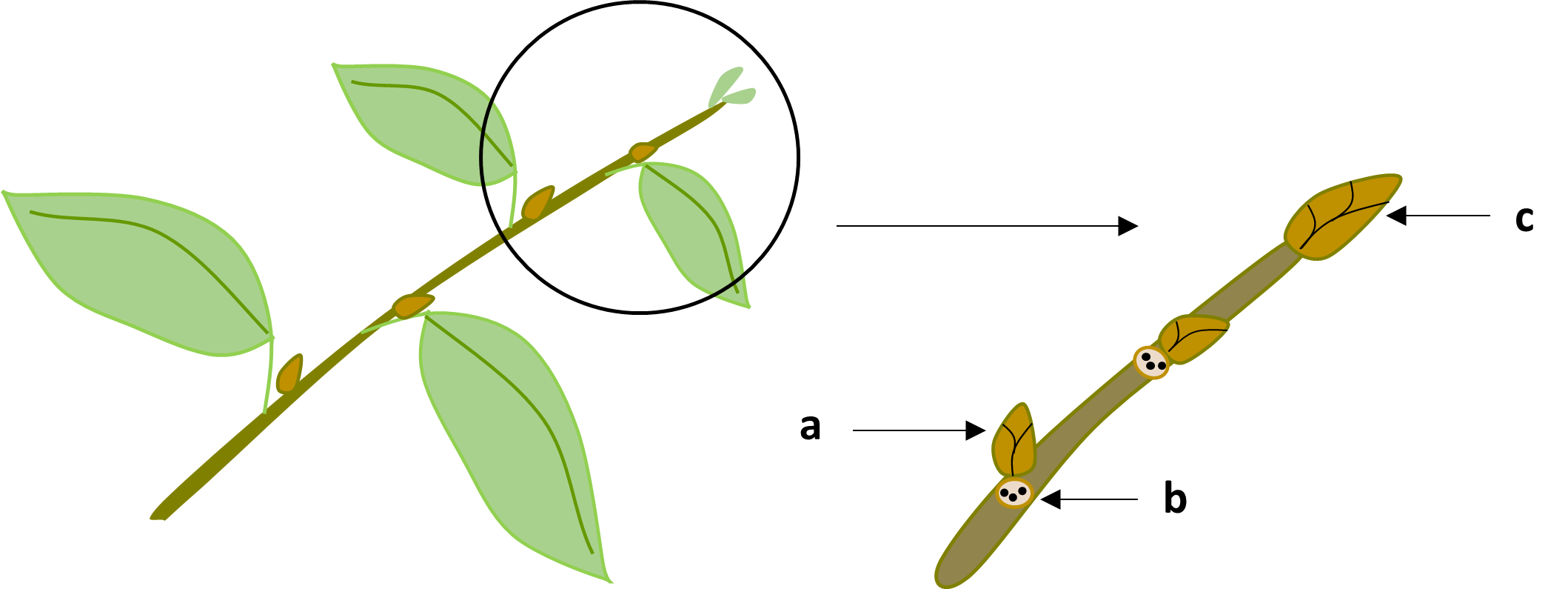
On trees and shrubs, a false terminal bud is a lateral bud at the end of a twig. Unlike a true terminal bud, it doesn’t enclose the growth at the tip of a stem or branch.

This happens in some species when growing shoots don’t harden off in fall. Instead, their stems die back, leaving the end-most lateral buds to take over as the last buds on the twigs.  

According to several keys, false terminal buds are found only on woody plants with alternate lateral buds. The stems of plants with opposite buds may also wither or die back before winter, but the end-most pair of buds are not called false terminal buds. 

This difference may seem trivial, but some winter keys use false and true terminal buds to separate species into groups or to confirm a plant’s identity. Fortunately, with a hand lens and some practice, there are reliable ways to recognize each.


True terminal buds

Consider a stem of a deciduous (leaf-shedding) tree or shrub with alternate leaves along its length and a growing shoot at its tip. By mid-summer, the plant begins forming buds in leaf axils, the angles between leaves and stems. These are axillary or lateral buds, also called leaf buds. When leaves are shed in fall, their petioles (leaf stalks) leave marks below these buds, called leaf scars.

At the same time, growth stops at the tip of the stem and the young shoot is enclosed in either bud scales or protective leaves. This is a true terminal bud (c). It has no leaf scar (b) below it, and it is often larger than lateral buds (a). 

A diagram of a branch that develops a true terminal bud, labeled "c," and lateral buds and leaf scars, labeled "a" and "b."
I


False terminal buds

Now consider a stem that, instead of forming a terminal bud, dies back to the closest lateral bud. This is a false terminal bud. It has a leaf scar below it and is about the same size as other lateral buds.

The stub of the withered stem may project above the base of the bud on the side opposite the leaf scar. The mark it leaves, called a branch scar (b), can be mistaken for a leaf scar, but it won’t have vascular bundle scars. This can be hard to see without a hand lens. Also, in some species with false terminal buds, the bud is noticeably angled toward or away from the twig (a).

A diagram of a branch that develops a false terminal bud, labeled "a," and the branch scar that sits above the base of the bud, labeled "b."


Examples

Black Walnut (Juglans nigra) is a tree with alternate buds (a) and heart-shaped or three-lobed leaf scars. The true terminal bud (b) is larger than the lateral buds and does not have a leaf scar. The last lateral bud (c) sits just below the terminal bud. 

A series of three photos showing lateral and true terminal buds of black walnut.


American Elm (Ulmus americana), another tree with alternate buds, has false terminal buds. In the photos below, a branch scar is evident above the base of the bud (a) and a leaf scar (b) is on the opposite side, below the bud. Like some other species with false terminal buds, the bud is angled. 

A series of three photos showing the false terminal bud, leaf scar and branch scar on a winter twig of American elm.


Silver Maple (Acer saccharinum) is a tree with opposite or paired lateral buds (a) and a true terminal bud (b) that is larger than the lateral buds and has no leaf scar (c). The last pair of buds (d) sits just below the terminal bud. 

Two photos showing the true terminal bud, opposite lateral buds and leaf scars on a winter twig of silver maple.


Basswood (Tilia americana) is a tree with alternate lateral buds and false terminal buds. Below, the false terminal bud has a leaf scar (a) and is about the same size as the lateral bud below it. The branch scar (b) is smaller and darker than the leaf scar. 

A panel of three photos showing the false terminal bud, leaf scar and branch scar on a winter twig of basswood.


Highbush Cranberry (Viburnum trilobum, V. opulus) is a shrub with opposite buds. It does not form terminal buds of any kind. Instead, in fall, the ends of the stems (a) wither back to the last pair of opposite buds (b), which will resume growth in spring. As this pattern repeats, the shrub branches in a Y-shaped form called sympodial growth (c).


Two photos showing stems of highbush cranberry withered back to the last pair of opposite buds. One photo shows the Y-shaped branching pattern that results from the growth of the lateral buds in spring.


Some Winter ID Guides

The following guides can help with winter ID of trees and shrubs. When using any guide or key, look at several twigs and buds to see what’s typical. Variations are common.

The LEAF Program from UW-Stevens Point is a K-12 forestry education initiative that offers many online resources. Under Curriculum & Resources, choose LEAF Tree Identification Tools. The LEAF Winter Tree ID Key is available there as a downloadable PDF.

Pocket Reference for Winter Tree Identification. Champaign County Forest Preserves, Mahomet, IL.

Fruit and Twig Key to Trees and Shrubs, by William M. Harlow, PhD. Reprint edition, 1959. Dover Publications, Inc., New York. ISBN 0-486-20511-8. 


Monday, December 19, 2022

Winter Identification of Deciduous Trees and Shrubs

Several ironwood trees with brown leaves in a snowy understory.


In winter, trees and shrubs can be identified using twigs, bark, overwintering fruit and sometimes leaves. This post offers some tips and terms for winter ID. A printable version is available for free through the Downloads tab.  


Tip #1: If they're within reach, look at twigs. 


A twig of green ash showing nodes, brown, blunt buds, and pale, semicircular leaf scars.


As in this photograph of Green Ash (Fraxinus pennsylvanica), look for the size, color, shape and texture of terminal, or end, buds and lateral, or side, buds (b). Lateral buds are attached at nodes (a) and are arranged in one of four patterns:
  • Alternate: One bud per node   
  • Opposite: Paired, or two buds per node
  • Subopposite: Paired but not quite opposite
  • Whorled: Three buds per node
Green Ash has opposite buds (d). 

The size and shape of leaf scars (c) can also help identify a species. These scars are left by petioles, or leaf stalks, when they fall from the tree. Green Ash typically has light, semicircular leaf scars.


Tip #2: Within leaf scars, look for vascular bundle scars.


These scars are made when strands of water- and food-conducting cells are severed in fall. Their size, number and arrangement are typical for a species. Some are easier to see with a magnifying lens. 

A series of three photos showing the vascular bundle scars of green ash, red elderberry and Catalpa.


Above left: Green Ash bundle scars are small, brown dots arranged in a semicircle.
Center: The bundle scars of Red Elderberry (Sambucus racemosa) are raised, irregular shapes arranged at the points and along the sides of a triangular leaf scar. 
Right: The bundle scars of Northern Catalpa (Catalpa speciosa) are light brown dots arranged in an oval.


Tip #3: Look at bark. 

Bark color and texture are helpful clues but can change with age. Also look for lenticels, spots or irregular shapes on the bark of younger trees or shrubs. In the photographs of Green Ash below, lenticels are the white spots on the reddish-brown bark of the sapling shown on the left (arrows).

On the right is a mature Green Ash showing the typical honeycomb-like pattern of ridges and furrows of its bark.

Two photos showing the reddish-brown, speckled bark of a green ash sapling and the gray, honeycombed bark of a mature tree.


Tip #4: Look for overwintering fruit.

Some species retain their fruits, or parts of them, well into winter. Also look under the shrub or tree for fruits that may be on the ground or on top of the snow.

A panel of four photos showing the overwintering fruits of winged burning bush, box elder, Kentucky coffee tree, and Amur cork tree.

Clockwise from top left: Red capsule walls of Winged Burning Bush, Euonymus alatus; samaras of Box Elder, Acer negundo; pods of Kentucky Coffee Tree, Gymnocladus dioicus, each 3 to 4 inches (7-10 cm) long; and the fruits of Amur Cork Tree, Phellodendron amurense


Tip #5: A few species hold on to their leaves.

Some trees are marcescent -- their leaves turn brown but aren't shed in fall. In this region, oaks (Quercus), Ironwood (Ostrya virginiana) and Blue Beech (Carpinus caroliniana) are among the few trees that are marcescent. 

Below is Ironwood, an understory tree that retains its leaves through winter. 

Ironwood trees with brown leaves in a snowy understory.


Tip #6: Remember MAD Cap Buck Horse.

Bud arrangement -- alternate, opposite, subopposite or whorled -- can quickly narrow choices for identification. One way to remember which species have an opposite arrangement is the mnemonic MAD Cap Buck Horse:

M            Maples (Acer)

A            Ash (Fraxinus)

D            Dogwoods (Cornus, except for alternate-leaved dogwood, C. alternifolia)

Cap        Plants that are or were in the family Caprifoliaceae, including honeysuckles (Lonicera), wolfberry or snowberry (Symphoricarpos), elderberry (Sambucus) and viburnums (Viburnum). 

Buck Horse    Ohio Buckeye (Aesculus glabra) and Horse Chestnut (Aesculus hippocastanum)


Although this mnemonic is helpful, it doesn't include all trees and shrubs with opposite buds. For example, Wahoo and Burning Bush, genus Euonymus, also have opposite buds. So does Bladdernut, Staphylea trifolia, an understory shrub.

Most remaining species have alternate buds. Common Buckthorn, Rhamnus cathartica, is unusual in having subopposite buds. Catalpa, another unusual species, has whorled buds. 


Tip #7: Look at the pith.

The pith is the center of a branchlet or twig. The appearance of the pith -- hollow or solid, color, texture -- can help confirm the identity of a tree or shrub. For example, honeysuckle shrubs (Lonicera, left photo below) have hollow piths, and Red Elderberry (Sambucus racemosa, right photo below) has a soft, yellow pith.

Two photos showing the cut twigs of honeysuckle and red elderberry.


Tip #8: Try these guides.

The LEAF Program from UW-Stevens Point is a K-12 forestry education initiative that offers many online resources. Under Curriculum & Resources, choose LEAF Tree Identification Tools. The LEAF Winter Tree ID Key is available there as a downloadable PDF.

Pocket Reference for Winter Tree Identification. Champaign County Forest Preserves, Mahomet, IL.

Fruit and Twig Key to Trees and Shrubs, by William M. Harlow, PhD. Reprint edition, 1959. Dover Publications, Inc., New York. ISBN 0-486-20511-8. 


Friday, November 11, 2022

Oriental Bittersweet in Winter

Oriental bittersweet fruits on bare winter vines twining around a shrubby host.
The yellow capsules and scarlet arils of Oriental Bittersweet stand out in winter.

Oriental, Asian or Asiatic Bittersweet (Celastrus orbiculatus) is an introduced vine that can girdle or smother its hosts. Efforts to remove this invasive plant are complicated by its similarity to native American Bittersweet (C. scandens).

Fortunately, mature female vines of each species are noticeably different, especially in fall and winter. Open this updated post from January 2021 to learn how to tell them apart. A two-page ID guide is free to download. 

Sunday, July 31, 2022

How to Identify Native and Introduced Phragmites

A colony of Phragmites grasses with last year's panicles.
Phragmites australis subsp. americanus. Photo taken in early August in southern Minnesota.


Update: An abbreviated ID guide (PDF) is here

Phragmites or Common Reed, Phragmites australis, is a 12- to 18-foot tall, perennial grass of wetlands, shorelines and ditches. Two subspecies are common in the U.S. One is the native subspecies americanus; the other is the introduced subspecies australis.

Both subspecies grow in colonies, but subspecies australis is more aggressive and can dominate habitats to the near exclusion of other plants. For that reason, there is growing interest in identifying and mapping subspecies australis to determine the extent of its spread and to target those colonies for removal.

Although the subspecies look alike, there are several characteristics that, taken together, can identify one from the other. The most reliable characteristics are shown below, after a few terms used to describe grass stems, leaves and flowers.

Stems and leaves

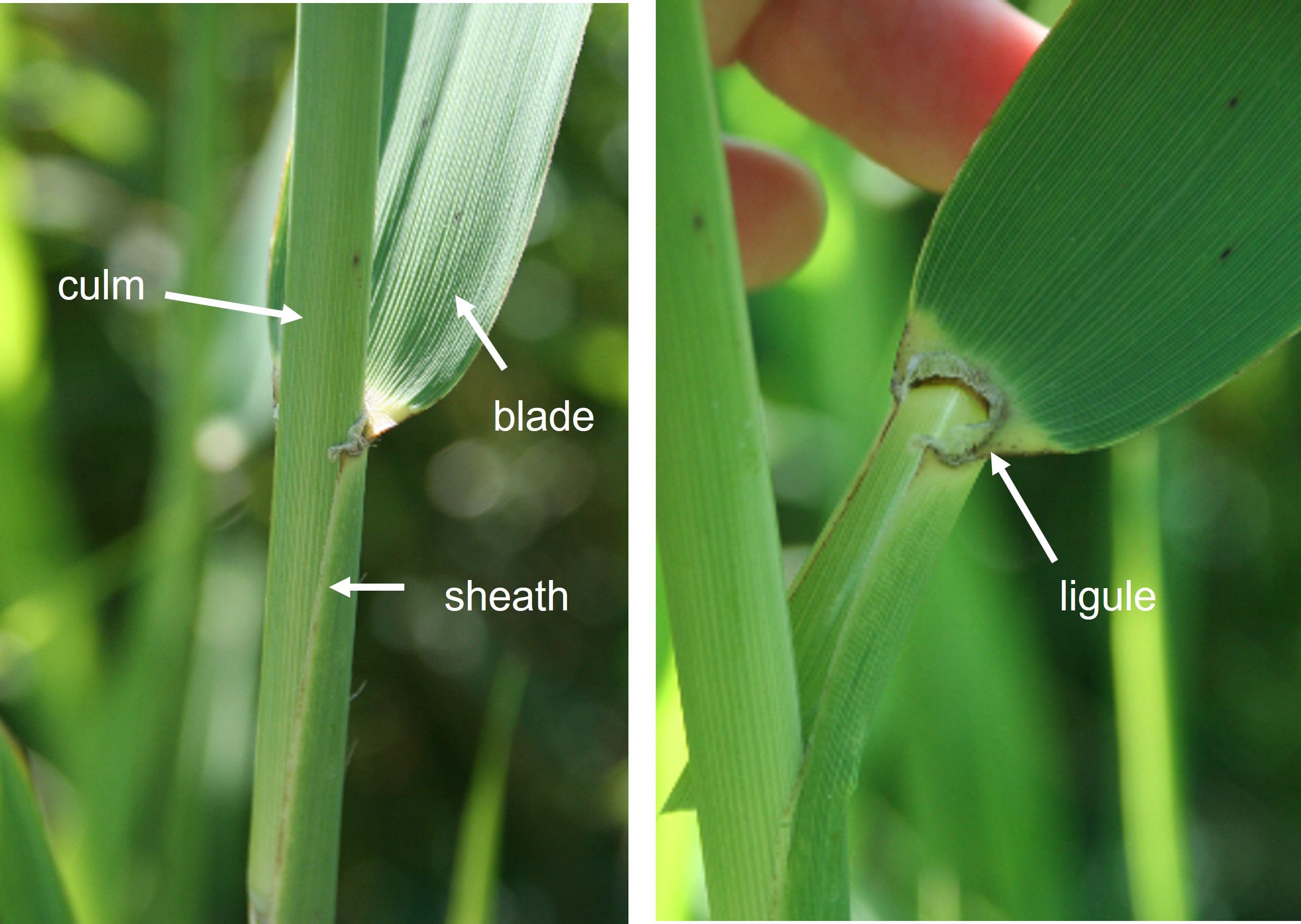
A panel of two photos labeling the culm, blade, sheath and ligule.


The culm is the stem of a grass. Grasses have round culms that are hollow between the nodes, the swollen areas on a culm. The leaf blade is flat and ribbon-like, whereas the leaf sheath wraps around the culm below the blade. Where the blade meets the sheath, most grasses have a ligule, a membrane or hairy fringe visible when the blade is pulled away from the culm.

Flowers

Grass flowers, called florets, are specialized for wind pollination. Each floret is composed of two narrow bracts, a lower lemma and an upper palea. Stamens and feathery stigmas emerge from between them.

Florets are arranged in small spikes called spikelets. At the base of each spikelet are two bracts called glumes. Glume length differs between the subspecies of Phragmites. More on that in a following section. 

Spikelets of Smooth Brome, Bromus inermis, are shown below. On the left are spikelets with brown anthers and feathery, white stigmas emerging from individual florets. On the right is a single spikelet spread apart to see the florets and glumes. The spikelets are about  3 cm (1.5 in.) long. 

A panel of two photos showing spikelets of smooth brome, with glumes and florets labeled.


Phragmites characteristics

To identify Phragmites subspecies, it’s best to look at more than one plant in a colony and at several characteristics of each plant. Hybrids are possible, but they’re said to be rare. 

Ligules 

To see ligules, pull back a blade from the middle third of the culm. (Ligules may be immature on the upper third of the culm and degraded on the lower third.) Ligule length differs between the subspecies. 

Subspecies americanus: 1-2 mm long, brown, become darker and smudgy in late summer and fall. The photo below was taken in early August.

Subspecies australis: 0.5-1 mm long, appearing as a thin, brown line. The photo below was taken in early July.

A panel of two photos showing the ligules of subspecies americanus and australis.


Stem color and texture
In summer and fall, examine the base of the culm. Be sure to look at the culm and not the sheath, if one is present. The photos below are from early July.

Subspecies americanus: Lower culm is smooth, somewhat glossy, often red.
Subspecies australis: Lower culm is ridged, not glossy, often green fading to brown.

The smooth, red lower stem of subspecies americanus and the green, ridged lower stem of subspecies australis.


Sheaths

In late summer, fall and early winter, examine the lower stem for the presence of leaf sheaths. The photos below are from mid-November.

Subspecies americanus: Sheaths are absent or easily removed.
Subspecies australis: Sheaths are persistent and harder to remove. 

The bare stem of subspecies americanus compared to the sheathed stem of subspecies australis in November.


Glumes

In late summer and fall, measure glume length. By late fall some of the florets may be gone, but the glumes often persist. It's best to look at several pairs of glumes to get an idea of their average length. The photos below are from mid-November.

Subspecies americanus: Lower glume 3-6 mm long (most > 4mm); upper glume 5-11 mm long (most > 6 mm).
Subspecies australis: Lower glume 2.5-5 mm long (most < 4 mm); upper glume 5-8 mm long (most < 6 mm).

The glumes of subspecies americanus and australis along a metric ruler.


Panicles

In late winter, spring or early summer, look at last season's panicles, the plume-like clusters of Phragmites spikelets. The photos below are from early July.

Subspecies americanus: Panicles bare, thinner, less branched.
Subspecies australis: Panicles fuzzier, thicker, more branched.

A panel of two photos contrasting the panicles of subspecies americanus and australis.


Look-alikes

Amur Silver Grass and Reed Canary Grass are two smaller grasses that can be mistaken for Phragmites. 

Amur Silver Grass, Miscanthus sacchariflorus, is an introduced grass that has silvery-white panicles in late summer and fall. It grows 6-8 feet tall, shorter than Phragmites, and its leaf blades have a white midrib. Its ligules are a greenish-white, hairy fringe. The photos below were taken in early August.

A panel of two photos showing a colony and a ligule of Amur Silver Grass.
Amur Silver Grass plants and ligule.


Reed Canary Grass, Phalaris arundinacea, blooms in spring, not late summer, with smaller panicles that eventually contract. It's shorter than Phragmites, growing up to 5 feet tall. Its ligules are membranous and 3-8 mm long. 

A panel of two photos showing a colony and a ligule of Reed Canary Grass.
Reed Canary Grass colony and ligule.


References

Chadde, S.W. 2012. Wetland Plants of Minnesota. 2nd edition (revised). A Bogman Guide.

Judziewicz, E. J., Freckmann, R.W., Clark, L.G., and Black, M.R. 2014. Field Guide to Wisconsin Grasses. The University of Wisconsin Press, Madison.

Minnesota Aquatic Invasive Species Research Center (MAISRC). Identifying invasive Phragmites. Website accessed July 2022.

Swearingen, J., Saltonstall, K., and Tilley, D. Phragmites Field Guide: Distinguishing Native and Exotic Forms of Common Reed (Phragmites Australis) in the United States. Technical Note Plant Materials 56, October 2012. USDA Natural Resources Conservation Service, Boise, ID.


Thursday, March 31, 2022

Flower Parts for Plant ID

White flower of large-flowered Trillium blooming on a forest floor.
Large-flowered Trillium, Trillium grandiflorum


Thanks to the four biomes that meet here, Minnesota hosts a diversity of plant life. According to the most recent MNTaxa plant checklist, the state is home to at least 2,250 species and varieties of vascular plants (1). Of those, about 94% are flowering plants, and most guidebooks focus mostly or entirely on that group. To help identify these plants, many wildflower guides rely on flower parts – their presence or absence, their number, their appearance –to arrive at a plant's name.

It’s useful, then, to know how flowers are put together. This post introduces basic flower structure, beginning with the names of flower parts and some common variations and then introducing some terms for flower clusters, called inflorescences. 

Flower parts

In a model flower, parts are organized in four whorls. From outermost to innermost, they are sepals, petals, stamens and one or more pistils. In some flowers, pistils are composed of joined parts, called carpels (seed leaves), to form a compound pistil. In others, the pistils are composed of only one carpel, so they’re called simple pistils. The diagram below shows a simple pistil.

Flower diagram showing sepals, petals, stamens and pistils.


All the sepals together form the calyx, from a Greek word describing a husk or a case for a bud. Many flower buds are enclosed in and protected by a calyx before they open. Similarly, all the petals together form the corolla, from a Latin word meaning wreath or crown.


Buds and pink flower of wild geranium showing calyx and corolla.


Each of the flowers below has all four parts. Sharp-lobed hepatica has flowers with multiple stamens, multiple simple pistils, five petals, and five sepals. Large-flowered trillium has three sepals, three petals, six stamens, and one compound pistil formed of three joined carpels. Three stigmas emerge from the top of the pistil.


Hepatica and large-flowered Trillium with four floral whorls.


The photo of wild geranium below shows two flowers in different stages of development. In the left flower, stamens are at peak maturity and are releasing pollen. The pistil in this flower is immature and hidden by the stamens. In the right flower, the stamens are past peak and are withering. The pistil, however, is in its prime, with five, curved stigmas ready to accept pollen.

Two pink wild geranium flowers at different stages of maturity.

Because the stamens and pistils mature at different times, the flower can’t pollinate itself. This difference in timing, called dichogamy (dy-COG-amee), favors cross-pollination and mixing of genes, creating more diverse -  and perhaps more successful – offspring. 

Tepals

Tepals are petals and sepals that look alike. They are especially common among plants in the lily family and its close relatives. Tulips and day lilies are two garden favorites that have tepals. Native white trout lily and blue-bead lily also have tepals.

Tepals of white trout lily and blue bead lily flowers.


Regular (actinomorphic) and irregular (zygomorphic) flowers

When viewed face on, regular flowers look like wheels or stars: Their parts are evenly distributed all the way around. More than one line can be drawn through the center of the flower to create similar halves. Such flowers are also called radially symmetric or actinomorphic, which means star-shaped.

In contrast, irregular flowers have only one plane of symmetry: Only one line can be drawn across their faces to produce similar halves. Irregular flowers are also called bilaterally symmetric or zygomorphic. “Zygo” is a Greek prefix meaning pair.

Regular flower of white avens and irregular flower of spotted jewelweed.


Complete and incomplete flowers

If flowers have all four parts – sepals, petals, stamens and pistils – they’re complete. If they’re missing one or more of these parts, they’re incomplete. Wild strawberry, for example, has complete flowers. The flowers of Canada anemone, however, have no petals and are incomplete. In that plant, sepals are the large, colorful parts that attract pollinators.

Flowers of wild strawberry and Canada anemone.


Perfect and imperfect flowers

These terms refer to the reproductive parts of a flower, the pistils and stamens. A perfect flower has both parts, whereas an imperfect flower has only one. A staminate flower has only stamens; a pistillate flower has only pistils.

If a species has imperfect flowers and the staminate and pistillate flowers are on the same plant, the species is monoecious (mon-EE-shus), meaning one house. If the species has staminate and pistillate flowers on different plants, it is dioecious (dy-EE-shus), meaning two houses. Sometimes dioecious plants are said to have separate “female” and “male” individuals.

Most flowers of silver maple, for example, are imperfect. Staminate and pistillate flowers are shown below. They may be on separate trees or on the same tree, so the plants can be dioecious or monoecious, respectively. Occasionally, a tree may also have perfect flowers.


Silver maple staminate and pistillate flowers.


Wind-pollinated flowers

Wind pollinated flowers don’t rely on insects to visit them, so they lack showy petals and sepals. Stamens and stigmas, however, are often numerous and obvious when the flowers mature. Silver maple, shown above, is wind pollinated, as are willows and aspens. Grasses are also wind pollinated. Two  prairie grasses, big bluestem and Indian grass, are shown below.

Protruding anthers and feathery stigmas of big bluestem and Indian grass.


Inflorescences

Some plants, like tulips or roses, produce flowers singly. Others produce flowers in clusters called inflorescences.

An aster, for example, isn’t one flower but many tiny ones, all clustered on a flat, rounded, or conical receptacle. The flowers in the center are called disk flowers. Those around the edge, often bearing petal-like rays, are called ray flowers. This arrangement, called a head inflorescence, is typical of plants in the aster or sunflower family.

Diagrams and photos of a head inflorescence and other common types are below. In the diagrams, black circles represent flowers. Different sizes of circles indicate that some flowers in an inflorescence mature sooner than others. The larger the circle, the earlier it opens. If all circles are the same size, they mature at the same time.


Head inflorescence of New England aster.


Spike of white prairie clover flowers and catkin of willow flowers.


Racemes of black cherry and Dutchman's breeches flowers.


Panicle of white flowers of false Solomon's seal.


Compound umbel of water hemlock flowers and fruits.


Compound corymb of yellow-green Norway maple flowers.


Cyme of St. John's wort.


Mixed inflorescences

Adding more challenge, some plants have mixed or combined types of inflorescences. Rough Blazing Star, for example, has heads arranged in a spike, and Showy Goldenrod has heads arranged in a panicle.

Spike of heads of rough blazing star and panicle of heads of showy goldenrod.


References

(1) MNTaxa: The State of Minnesota Vascular Plant Checklist. Minnesota Department of Natural Resources. Accessed March 30, 2022, online at https://www.dnr.state.mn.us/eco/mcbs/plant_lists.html.

(2) Minnesota Wildflowers: A field guide to the flora of Minnesota. Online at minnesotawildflowers.info.


Pioneers

An area cleared for restoration gives one group of plants just the opening they need.  Once bare soil, this area is now full of pioneers, pl...