Showing posts with label People & Plants. Show all posts

Monday, November 24, 2025

The Burning Bush Story

Winged burning bush in a wooded understory. Its bright red fall color makes it easy to identify. 


Winged burning bush, Euonymus alatus, is beautiful in fall. Its vibrant orange to red-purple leaves are striking, and it has been widely planted for its burst of late-season color.

In Minnesota, however, the species and its cultivars are no longer available. Many homeowners and landscapers have been disappointed that the shrub is now considered invasive and is legally prohibited from sale. Some question this decision, saying that burning bush doesn’t spread to natural areas – not in great numbers, anyway.

What’s the story of burning bush? What evidence supports the claim that it invades natural areas? And if it does, what harm does it cause?
 

First Arrival


Winged burning bush is originally from northeast Asia, where it grows in forests, woodlands and shrub-dominated scrublands. Someone – it’s unknown who – introduced it into North America in the mid-1800s as an ornamental shrub prized for its winged stems, bright fall color and abundant red fruits (1).

Left: Burning bush in its blazing fall color. Center: Stems and older branches have corky wings. Leaves are opposite. Right: Reddish capsules open in fall to release seeds enclosed in bright red arils, or fleshy seed coverings.

By the early 1900s, burning bush had entered the nursery trade, and by the mid-1900s the shrub and its cultivars were well known. Plant catalogs from that time promote the plant’s fall color and attractive fruits. In 1934, Breck’s catalog included burning bush among several desirable shrubs, writing, “Those who enjoy having birds around their home will find no better way of attracting them” than to plant them (2).

In 1949, Adams Nursery wrote in its catalog, “No doubt one of the most conspicuous varieties in the autumn, with its brilliant scarlet foliage and fruits,” adding that one of the shrub’s cultivars is “[i]ndifferent to soil, shade, and city conditions.” In other words, it will grow just about anywhere it’s planted (3).

Other advertisements were similarly positive. Burning bush, they all said, is an ideal plant for a shrub border, foundation planting, specimen planting or other uses. At the time, there was no mention of it naturalizing.

Early Concerns


As burning bush became widely planted, observations of its unintentional spread started to accumulate. In 1973, botanists John Ebinger and Loy Phillippe published what may be the first documented observation of burning bush spreading beyond intentional plantings (4). During field work in Illinois, they found a sizeable, self-sustaining population of Euonymus alatus on a wooded hillside and valley. They wrote:

“The population studied dominates the understory in the more shaded parts of a north facing hillside and valley floor, being particularly abundant in small ravines. The entire population extends over an area of about 4 acres …. Numerous smaller plants and seedlings are also common.”

For the next 10 years, John Ebinger studied that site and documented what he found. In a 1983 report (5), he wrote that the burning bush population had expanded to 3 hectares (about 7.4 acres), with some plants more than 30 years old. Small plants and seedlings were still common. On the north-facing hillside, the seedling density was an average 138,500 per hectare (2.471 acres) and the density of saplings was an average 1,100 per hectare. On the ravine floor, the seedling density was an average 150,000 per hectare, and the density of saplings was an average 1,700 per hectare. He also noted that the population had almost doubled in number, and plants had spread to the forest edge and a nearby field.

About the plant’s invasive ability, he wrote, “Although not a major problem in natural areas, winged wahoo [another common name for Euonymus alatus] does have the potential to spread into good quality forests since it can grow and reproduce in dense shade. Most of the reproduction observed is from seeds falling from established plants. However, birds do regurgitate the seeds soon after ingesting them, and some seeds have been found to be viable after passing through the digestive tract.”

Later Decades


From the 1990s to the present, reports of naturalized burning bush have increased across North America. The greatest number are from the northeast US, but the plant is also spreading in the Midwest, including Minnesota. The map below is from EDDMapS, a reporting system for introduced plants that have become naturalized (6). Record density by county (or the equivalent in Canada) is indicated by color; the darker the shade, the greater the density.


Some of these reports are in or near natural areas, such as parks, forests, refuges and shorelands. For example, locations selected from the map above include Bedell Bridge State Park in New Hampshire, Griffy Lake Nature Preserve in Indiana, and Elroy-Sparta State Trail in Wisconsin. In Minnesota, burning bush has been reported in the Richard J. Dorer Memorial Hardwood State Forest, Great River Bluffs State Park, the Minnesota Valley National Wildlife Refuge and the Lower St. Croix National Scenic Riverway, among other places.

Some of these reports are of single plants or a few scattered individuals. Others document higher density populations or even monocultures. The photographs below are from a wood line between a private residence and the Richard J. Dorer Memorial Hardwood State Forest, where photographer Peter M. Dzuik noted full canopy closure by mature shrubs and nearly full cover of the ground layer by seedlings (EDDMapS report 5235347.)


Impacts and Intervention


Clearly, burning bush can be invasive. With enough time and in favorable circumstances, a few naturalized shrubs can turn into many, including in natural areas. Looking back, it’s not surprising that burning bush can spread. Some of the qualities that made it popular, namely its wide tolerance of growing conditions, its abundant fruit production and its ability to attract birds, are traits common to many invasive plants (7).

Those traits helped burning bush spread to many habitats, and where its cover is extensive and dense, its effects are significant. In its 2019 assessment of burning bush (8), the Minnesota Department of Agriculture’s Noxious Weed Advisory Committee (NWAC) concluded in part that burning bush and its cultivars can “aggressively displace native species through competition” and have “the potential to change native ecosystems” by forming dense thickets and ground layers. The NWAC also noted that burning bush invades not only forest understories but also prairies, pastures and coastal shrublands. (See question 8 in the Assessment Worksheet; it includes several references.)

As a result, the committee recommended adding burning bush to Minnesota’s Noxious Weed List in 2020, initially designating the species and its cultivars as Specially Regulated (9). After a three-year phase-out period, the plant was moved to the Restricted list, meaning it can’t be “imported, sold, or transported in the state” without a permit. It also means that burning bush has become so widespread in Minnesota that eradicating it or preventing it from reproducing isn’t realistic.

How To Identify Burning Bush


It’s easy to identify burning bush in fall, when its bright red-orange color and red fruits make it obvious. At other times of the year, its winged stems and opposite leaves (or buds) are helpful characteristics. A native burning bush (Euonymus atropurpureus), also called eastern wahoo or spindle tree, is found in southern Minnesota, usually in lowlands but sometimes in uplands (10). Its stems are squarish in cross section, with shallow ridges or faint lines along the angles. Unlike the stems of Euonymus alatus, they lack well-defined wings.

 
In late fall and winter, burning bush can be identified by its winged stems and red fruits.


For more information about either species, see these Minnesota Wildflowers pages: Euonymus alatus, Euonymus atropurpureus.  


References

1. Winged Euonymus (Euonymus alatus). iNaturalist. Website accessed November 15, 2025.

2. Joseph Breck & Sons., et al. 1934, Everything for Farm, Garden & Lawn. Joseph Breck & Sons, 1934, https://www.biodiversitylibrary.org/item/269483.

3. Adams Nursery. & Henry G. Gilbert Nursery and Seed Trade Catalog Collection. (1949). 100th anniversary, 1849, 1949. Adams Nursery, Incorporated. https://www.biodiversitylibrary.org/item/304370

4. New Plant Records for Illinois. John E. Ebinger and Loy R. Phillippe. Transactions of the Illinois State Academy of Science Vol. 66. No. 3 & 4, page 115.

5. Exotic Shrubs: A Potential Problem in Natural Area Management in Illinois. John E. Ebinger. Natural Areas Journal Vol. 3, No. 1. pages 3-6. 1983.

6. EDDMapS. 2025. Early Detection & Distribution Mapping System. The University of Georgia - Center for Invasive Species and Ecosystem Health. Available online at http://www.eddmaps.org/; last accessed November 23, 2025.

7. Exotic, Invasive Plants 101: Characteristics and Identification. Belinda Eshan. Natural Resources Conservation Service (NRCS) and Tennessee Exotic Pest Plant Council (TNEPPC). 2012.

8. Assessment Worksheet for Winged Burning Bush. Noxious Weed Advisory Committee, Minnesota Department of Agriculture. 2019.

9. Minnesota Noxious Weed List. Minnesota Department of Agriculture. Website accessed Nov. 11, 2025.


10. Trees and Shrubs of Minnesota. Welby R. Smith, Minnesota Department of Natural Resources. University of Minnesota Press, 2008. 

Sunday, September 7, 2025

Plant Profile: Ragweeds

 Common ragweed, Ambrosia artemisiifolia, and great ragweed, A. trifida.

Common ragweed, Ambrosia artemisiifolia, flowering in late August. 


For people with seasonal allergies, ragweeds are beasts.

Pollen from these plants, also called hay fever weeds, cause much of the sneezing, watering eyes, coughing, wheezing and other symptoms that torment allergy and asthma sufferers in late summer and early fall.

Both great ragweed and common ragweed, the two species frequently found here, are native annuals. They’re often found along roadsides, in abandoned lots, along field edges and in other disturbed places. Most seeds germinate in early spring, but some may germinate as late as July. Flowering peaks in August and September and lasts until the first frost.

Common ragweed plants are 1-3 feet tall at maturity. Leaves are opposite below and alternate above, divided and deeply lobed, to 6 inches long and 4 inches wide at the base.


Great ragweed is 3-12 feet tall at maturity. Leaves are opposite, the lower ones three-lobed and the upper ones simple and ellpitical. Largest leaves grow up to 12 inches long and 8 inches wide.


Ragweeds produce separate staminate (male, or pollen-producing) and pistillate (female, or seed-producing) flower heads on spike-like racemes. Both kinds of flowers are found on the same plant; in other words, the plants are monoecious (mo-NEE-shus). Staminate flowers are grouped into stalked, downward-facing heads on the upper part of each raceme. Pistillate flowers are clustered below, often nestled in leaf axils.

After pollination, pistillate flowers develop small diamond- or top-shaped fruits with a central “beak” surrounded by ridges, each ridge ending in a short spine. The fruits look like miniature crowns, so ragweeds are also called crown weeds. Each fruit contains a single seed, and an individual plant of either species can produce thousands of seeds each season. Common ragweed seeds are viable in soil for two to three years and up to 40 years (3). Giant ragweed seeds are less durable; most lose viability after one year (4).
 

Left: Great ragweed racemes are 3-8 inches long. Right: Closer view of ragweed flower heads. Staminate heads are stalked and face downward. Pistillate heads contain only one flower. The one at the arrow has been pollinated and a young, green fruit is developing. Common ragweed racemes are shorter but otherwise similar.


Both types of flowers are small and simple; they have no large, colorful petals. That’s because the plants are primarily wind-pollinated and therefore don’t invest in structures needed to attract insects. Typical of wind-pollinated plants, the staminate flowers produce tremendous amounts of pollen. Many sources state that a single plant can release up to 10 million pollen grains a day and up to 1 billion grains a year.

It’s unclear where those numbers come from, but recent studies confirm similarly large amounts. In France, where ragweed is introduced and invasive, researchers found that a single common ragweed (A. artemisiifolia) produces from 100 million to 3 billion pollen grains per season (1). A study of intact vs. mowed common ragweed in Quebec found that an intact plant produces more than 100 million pollen grains per season (2).

These great ragweed leaves are dusted with yellow pollen.
Those millions of grains, multiplied by the number of plants that can densely fill an optimal habitat, present a serious health threat to people with ragweed allergies. The plants do have some ecological benefits, however. As colonizers of disturbed places, they can hold soils in place as other plants succeed them. In addition, their protein- and oil-rich seeds are eaten by migrating and winter-resident song birds and game birds, as well as by chipmunks, voles, and other rodents.

Beastly or beneficial, ragweeds are an enduring part of our landscape. Maybe that’s why Linnaeus put them in the genus Ambrosia, Greek for “immortal,” “divine,” or “food of the gods.” Given the seeminly unending symptoms ragweed pollen can cause, the first meaning, immortal, seems to fit. The last two, though, are hard to fathom. Ragweeds are indeed persistent. But for allergy sufferers, they are anything but divine.


References 


1. Boris Fumanal, Bruno Chauvel, François Bretagnolle. 2007. Estimation of the pollen and seed production of common ragweed in Europe. Annals of Agricultural and Environmental Medicine (AAEM) 14 (2), pp. 233-236.

2. Simard M.J., and Benoit, D.L. 2011. Effect of repetitive mowing on common ragweed (Ambrosia 
artemisiifolia L.) pollen and seed production.
Annals of Agricultural and Environmental Medicine (AAEM)18 (1), pp. 55–62.

3. Cornell College of Agriculture and Life Sciences. Common ragweed. Website accessed 9/5/25.

4. The Ohio State University. College of Food, Agricultural, and Environmental Sciences. Giant ragweed: A weed of extremes. 9/27/16.


Sunday, September 17, 2023

Snakeroot's Secret

White snakeroot, Ageratina altissima, flowering in a woodland edge in August.

In the fall of 1818, a 35-year-old pioneer woman fell ill and took to her bed in a crude dwelling near Pigeon Creek in Indiana. She had been caring for her sick relatives and a neighbor before she came down with the same symptoms: lethargy, abdominal pain, fever, nausea, and worse.

She had no medical care, so her health declined quickly. In a matter of days, she slipped into a coma, but before she lost consciousness, she called her two children to her side. When she died, her nine-year-old son, Abraham, is said to have been devastated. He would later write that his mother, Nancy Hanks Lincoln, made him all that he was.

Called sick stomach and later milk sickness, the mysterious illness was a menace on the 1800s wooded frontier. It sickened and killed thousands and terrified thousands more, because its cause was unknown. Faced with the agonizing and unexplained deaths of their family and friends, many pioneers abandoned their settlements for what they hoped would be healthier locations. In some cases, entire towns were deserted, as told by a writer to the Farmers’ Register in 1834:

A Village Depopulated by the Milk Sickness

The following extract is of a letter from a traveler dated at St. Louis:

A few miles below Alton, on the Mississippi, I passed a deserted village, the whole population of which had been destroyed by the “milk sickness.” The hamlet consisted of a couple of mills and a number of frame houses, not one of which was now tenanted; but the dried weeds of last year choaked [sic] the threshold of the latter, and the raceways of the mills were lumbered up with floating timber, while the green slime of two summers hung heavy on the motionless wheels. Not an object but ourselves moved through the town; and the very crows themselves seemed to make a recruit around the fatal place when they came in view of the thickly sown burial ground on the skirts of the deserted village. (1)

Although the settlers often found the illness again in their new homes, their knowledge was building. They recognized that cattle stricken with “the trembles,” a shaking weakness that progressed to more severe illness, could cause a similar condition in people who drank the cows’ milk or ate their beef, butter, or cheese. The illness tended to appear later in the season, from mid-summer through fall, and it was worse in dry years. Newcomers to areas stricken with the illness were advised to avoid eating beef or dairy products from July to the first frost.

That good advice likely prevented many cases of illness, but the ultimate cause of milk sickness remained unknown, or at least debated, for decades. In hindsight, it didn’t have to be. Unfortunately for many who would later become ill, an early and accurate warning was largely missed, in part because it came from a woman. Actually, from two women.

In Illinois around 1830, Anna Pierce Hobbs Bixby, a nurse and midwife called Doctor Anna, was grieved about the cause of milk sickness. It had killed her mother and sister-in-law and it had disabled her father, who developed a chronic, disabling form of the illness called “the slows.” She suspected the cause was something cattle were eating, so she followed them into their wooded pasture to record what they ate.

While she was there, she is said to have met an elderly Shawnee woman hiding from forced relocation to a reservation in Kansas. After the elderly woman learned what Doctor Anna was looking for, she identified white snakeroot as the plant that was making animals and people sick. The women parted, and the fate of the Shawnee elder is lost in history.

Now known by the scientific name Ageratina altissima (formerly Eupatorium rugosum, E. ageratoides, and E. urticaefolium), snakeroot’s phenology matched the seasonality of the sickness. It flowers in mid-summer into early fall, coinciding with the time milk sickness tended to occur. Its habitat was another good match. Snakeroot grew in woodlands, including the forested pastures where cattle then commonly grazed, and it persisted in drought. When they had no choice, cattle ate snakeroot.

White snakeroot range in North America (left) and the upper Midwest (right). USDA NRCS 2023.

With this new-found knowledge, Doctor Anna began experimenting. She fed the plant to animals, including calves, and found that they developed the trembles. Convinced that she had found the cause of milk sickness, she spread the word. She grew a garden of white snakeroot to teach others what it looked like, and she urged farmers to pull it out of their pastures. They did, and her advice is thought to have saved many lives, at least in southeastern Illinois.

But that’s as far as it went. Whether her work was dismissed or not widely published or both, it didn’t get much traction. Instead, physicians and settlers alike continued to speculate about the cause of milk sickness. They blamed all kinds of things: arsenic or other metals, bacteria, bad water, poison oak, poison ivy, and other agents. Some blamed miasmas, imaginary, poisonous exhalations from the earth that misted the vegetation and sickened the cattle.

As the debate continued through the 1800s, milk sickness nearly vanished. That was another mystery, although a welcome one. Two hundred years on, we know why it disappeared: Cattle came to be pastured not in the woods but in cultivated pastures where snakeroot was excluded, and commercial operations combined and diluted milk from many sources. If the contaminant was present in the milk, it was at lower concentrations, too low to produce the severe illness caused by chronic consumption of tainted meat and dairy products.

Even as milk sickness waned, research continued into its cause. The poisonous-plant hypothesis eventually held after other possibilities were eliminated, and snakeroot was finally confirmed as the cause of the illness in the early 1900s, almost 100 years after the Shawnee woman and Doctor Anna warned of its dangers.

In 1928 or 1929, James F. Couch, a chemist with the USDA, identified the toxin in snakeroot that had caused so much suffering. He described it as “a viscous . . . oil with a pleasant aromatic odor” and named it tremetol after the tremors it caused (2). The compound is present in all parts of the plant and is also found in rayless goldenrod, aka jimmyweed (Isocoma pluriflora), a plant native to the Southwest.

Milk sickness, or chronic tremetol poisoning, is rare now, but the University of Minnesota includes snakeroot among the plants known to be poisonous to livestock. While there is some concern that a return to small-scale, “natural milk” could result in cases of (now treatable) milk sickness, today white snakeroot is more often appreciated as a late-season source of nectar or pollen for bees, wasps, and flies and as a likely host plant for moth larvae (3). It’s available from many native plant nurseries – with some history attached.

To learn how to identify white snakeroot, see this page from the Friends of Eloise Butler Wildflower Garden.

Cited References

(1) A Village Depopulated by the milk sickness. Farmers' Register. Oct1834, Vol. 2 Issue 5, p308-309. 2p. [Obtained through the Hennepin County Library’s database of  American Antiquarian Society (AAS) Historical Periodicals Collection: Series 2.]

(2) Trembles (or milk sickness). James F. Couch. Circular No. 306, United States Department of Agriculture. 1933. https://archive.org/details/tremblesormilks306couc/page/n1/mode/2up

(3) White snakeroot. Illinois Wildflowers, website accessed 9-17-23. 

Additional References

Milk Sickness. Curtis Wood, NCPedia, 2006.

The “Slows”: The Torment of Milksickness on the Midwest Frontier. Walter J. Daly, Indiana Magazine of History 102 (1): 29-40, March 2006.

The Death of Nancy Hanks Lincoln. Philip D. Jordan, Indiana Magazine of History 40 (2): 103-110, June 1944.

Religion and Removal among the Shawnee from Ohio into Kansas. Brady DeSanti, International Journal of Humanities and Social Science 3 (4): 46-56.

How an 1800s Midwife Solved a Poisonous Mystery. Will McCarthy, Smithsonian Magazine, July/August 2023. [Note: A photograph in the article incorrectly labels white snakeroot flowering in spring. It flowers in mid-summer to fall.]

USDA, NRCS. 2023. The PLANTS Database (http://plants.usda.gov, 09/17/2023). National Plant Data Team, Greensboro, NC USA.

Wednesday, April 12, 2023

What Are Catkins -- and Why Does "Gesundheit" Come to Mind?

A branch of quaking aspen with several clusters of hanging, cylindrical, fuzzy catkins.
Catkins of quaking aspen, Populus tremuloides, began emerging in March in southern Minnesota. This photo was taken in mid-April.


Catkins, also called aments, are cylindrical, sometimes pendant clusters of inconspicuous flowers. They are typical of willows, aspens, poplars, birches, alders, hazelnuts and ironwood trees and shrubs. All these plants bloom in spring, often before leaves emerge, and most are wind pollinated. Willows are also insect pollinated and can be an important source of pollen and nectar for early-emerging insects, including those that later pollinate crops (1).

Catkins contain either male (pollen producing) or female (seed producing) flowers on the same or different plants. Ironwood (Ostrya virginiana), hazelnuts (Corylus spp.), birches (Betula spp.) and alders (Alnus spp.) have male and female catkins on the same plants, so they’re said to be monoecious (mon-EE-shus), which means “one house.”

In contrast, aspens and poplars (Populus spp.) have male and female catkins on different plants, so they’re dioecious (di-EE-shus), meaning “two houses.” Willows (Salix spp.) are also dioecious.

The emergence of catkins and the release of pollen marks not only the beginning of spring but also the start of allergy season. Wind-pollinated plants tend to produce abundant pollen because the grains could land anywhere – perhaps on a female flower of the same species, but maybe on those of a different species or even on no plant at all. Such as on you.  

Flurries of pollen may add to the misery for allergy sufferers, but for aspens, willows, and similar plants, they’re an insurance policy. The possibility of a next generation literally blows in the wind, so the more pollen, the better. "Gesundheit" for one, then, is good fortune for the other. 

Reference

1) Ostaff, D. P., Mosseler, A., Johns, R. C., Javorek, S., Klymko, J. and Ascher, J. S. 2015. Willows (Salix spp.) as pollen and nectar sources for sustaining fruit and berry pollinating insects. Can. J. Plant Sci. 95: 505[1]516. DOI:10.4141/CJPS-2014-339.


Wednesday, November 3, 2021

How Did Bittersweet Nightshade Get Its Name?

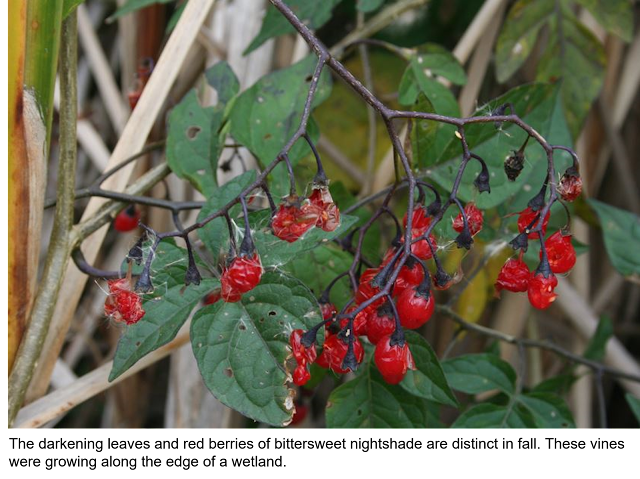
Branchiing stems of bittersweet nightshade with dark green leaves and red berries.

Warning: Bittersweet nightshade is poisonous. Don’t eat it.

Bittersweet nightshade, Solanum dulcamara, takes part of its common name from its taste. Its leaves and stems taste bitter and then sweet as its chemical components break down. The species name dulcamara comes from that quality. It's a combination of the Latin root words dulc, meaning sweet, and amar, meaning bitter.

The origin of “nightshade” isn’t as clear. One explanation is that it comes from the narcotic effect of many plants in the genus Solanum. Bittersweet nightshade and its relatives contain solanine, an alkaloid that affects the nervous system. The solanine content of this plant is highest in its leaves and green fruits but eating any part can cause stomach upset, drowsiness, dizziness, delirium and in severe cases respiratory failure and death.

Less ominously, “nightshade” could also come from the shady habitats where these plants may grow. Another origin could be the black berries that some Solanum species produce. Bittersweet nightshade isn’t one of them – its fruits are red at maturity – but other nightshades are well known for their black fruits.

One of them is the highly toxic Atropa belladonna, commonly known as deadly nightshade or simply belladonna. The black berries of this plant are high in atropine, an alkaloid now used to dilate pupils for eye exams, treat low heart rates and counteract other poisons, among other medical uses. In earlier times, however, people used belladonna for other purposes, with some risk. During the Renaissance, Venetian women dropped diluted berry juice into their eyes to dilate their pupils, a look considered beautiful at the time. That effect is captured in the species name belladonna, meaning “beautiful woman.” 

There were darker uses for belladonna. Ancient Romans are said to have incapacitated or killed their enemies by contaminating their food supply with the plant, and stories abound of its use as an assassin’s poison. Accidental poisonings still occur from misuse of herbal products or ingestion of berries mistaken for blueberries or other edible fruits.

Bittersweet nightshade isn’t as poisonous as belladonna, but it’s still best to be cautious. Its name speaks of its chemistry and the long, sometimes perilous history of the nightshade group. Before grabbing a handful of its berries, heed its name. It says beware.


More about Bittersweet Nightshade


Also called woody nightshade or climbing nightshade, bittersweet nightshade is an
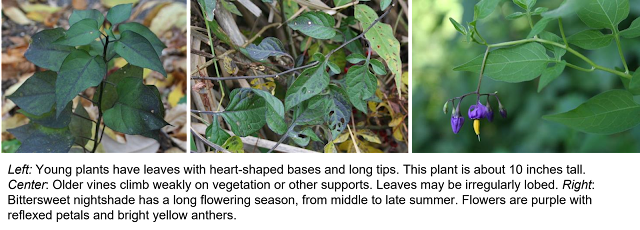
introduced vine now found throughout much of North America. It’s often associated with disturbed sites, especially those with wet or moist soils. Wetland edges, lakeshores, riverbanks, and deciduous forests are typical habitats. The vine grows up to twenty feet long, clambering over other plants or weakly twining around trees, shrubs or fences for support. In this region, bittersweet nightshade flowers from June to September. Fruits are oval, tomato-like berries about ½ inch long. They ripen from green to yellow, orange and eventually red. 


A young plant, older vine and purple flowers of bittersweet nightshade.


This introduced plant can be aggressive, especially in wet habitats that favor robust growth. It should be removed from places where children, pets or livestock may eat its leaves, stems or fruits.

Bittersweet Nightshade is in the family Solanaceae, a group that also includes tomatoes, peppers, eggplant and potatoes. Tomatoes, peppers and eggplants are edible fruits; they contain little or no solanine. Potatoes tubers are also edible unless they’re exposed to sun and turn green from chlorophyll. Chlorophyll isn’t poisonous, but it shows that solanine may have accumulated in the tuber and could cause illness.


References

USDA Forest Service. The Powerful Solanaceae. Solanaceae (fs.fed.us). Website accessed October 30, 2021.

Kandeler, R., and Ullrich, W.R. Symbolism of plants: examples from European-Mediterranean culture presented with biology and history of art: August: bittersweet, woody nightshade. https://www.cabi.org/isc/abstract/20093251708. Website accessed October 30, 2021.

Flora of Wisconsin. Solanum dulcamara. https://wisflora.herbarium.wisc.edu/taxa/index.php?taxon=8664. Website accessed October 29, 2021.

Waggy, Melissa A. 2009. Solanum dulcamara. In: Fire Effects Information System, [Online]. U.S. Department of Agriculture, Forest Service, Rocky Mountain Research Station, Fire Sciences Laboratory (Producer). Available: https://www.fs.fed.us/database/feis/plants/shrub/soldul/all.html [2021, October 27].


Wednesday, June 30, 2021

Some Uncommon Things About Common Milkweed

Common Milkweed, Asclepias syriaca, blooming on June 30, 2021, at Crow Hassan Park Reserve in Minnesota.


At times reviled as a nuisance of farm fields and pastures, Common Milkweed (Asclepias syriaca) has gained new respect as a plant that supports Monarch Butterfly larvae. That’s just part of the story, though. Here are a few things about milkweed that get less attention.

  • The plant’s scientific name, Asclepias syriaca, is centuries old. It was given by Carl Linneaus, the Swedish botanist who in the 1700s developed the binomial system of nomenclature. That's the system that gives plants and other living things two names: a generic name – Asclepias, in this case – and a specific name, also called a specific epithet –syriaca for Common Milkweed.
  • Linneaus is said to have been so impressed by the many medicinal uses of common milkweed that he named the plant after Asklepios, the Greek god of medicine. The specific epithet, syriaca, is from Linneaus’ mistaken belief that the plant came from Syria.  

  • Syria is a long way from where common milkweed is naturally found. The plant is native to the Eastern and Great Plains regions of the U.S. and adjacent provinces of Canada. Like many plants, however, common milkweed has found its way overseas. It is now also found in southern and central Europe, where it invades grasslands and farm fields (1).

  • One reason the plant isn’t always welcome is because it’s toxic to many animals, including humans. Like other milkweeds, the plant’s white latex contains cardiac glycosides, compounds that affect the function of the heart. Depending on the amount consumed, milkweed latex can cause symptoms ranging from nausea and vomiting to slowed heart rate, coma and even death (2).

  • Some animals can eat milkweed safely. Milkweed bugs, for example, can isolate the cardiac glycosides they consume while they munch on leaves and other plant parts. The insects themselves then become toxic, which makes them unpalatable to predators. Their bright colors warn potential diners that eating them would be a mistake (3).

  • Evidently, milkweed bugs have a lot of company. According to the U.S. Forest Service, common milkweed is a “mega food market” that feeds more than 450 kinds of insects. Some, like milkweed bugs, are destructive, but others merely sip the plant’s nectar or suck out its sap (4).

  • Medicinal uses of common milkweed have waned, but not long ago, the plant saved lives in a different way. During World War II, milkweed pods were collected for the silks attached to their seeds. The buoyant, waterproof strands, called milkweed floss, were used to stuff life preservers when kapok, another plant fiber used for that purpose, could not be obtained from Indonesia.

  • Milkweed floss was in such demand that school children were paid to gather the pods. The going rate was15 to 20 cents per onion bag or gunny sack filled with pods. Two bags provided enough floss to make one life preserver.

  • Although it’s hard to imagine milkweed floss making much difference in the effort, the plant was abundant enough to have made an estimated 1.2 million life preservers. Milkweed was so valuable that the U.S. government considered it a “wartime strategic material” (5).

  • After the war, common milkweed lost its status and was once again considered a weed. From reviled to revered and back again, shifting fortunes seem to define milkweed’s history.

References

(1) Asclepias syriaca (common milkweed). CABI Invasive Species Compendium. Viewed 6/30/21 at https://www.cabi.org/isc/datasheet/7249.

(2) Milkweed Plant Can Cause Serious Poisoning. Poison Control, National Capital Poison Center. Viewed on 6/30/2021 at https://www.poison.org/articles/milkweed-can-cause-serious-poisoning-204.

(3) Common Milkweed Insects. Susan Mahr, University of Wisconsin-Madison. Wisconsin Horticulture, Division of Extension. Viewed on 6/30/21 at https://hort.extension.wisc.edu/articles/common-milkweed-insects/.

(4) Plant of the week: Common milkweed (Asclepias syriaca).  David Taylor. U.S. Forest Service, USDA. Viewed on 6/30/2021 at Common Milkweed (fs.fed.us).

(5) A weed goes to war, and Michigan provides the ammunition. Gerald Wykes, from Michigan History magazine. Posted February 4, 2014, and updated January 20, 2019, on MLive. Viewed on 6/30/2021 at https://www.mlive.com/news/2014/02/a_weed_goes_to_war_and_michiga.html


Thursday, December 3, 2020

Sunset for Kentucky Coffee Tree?

Its numbers are declining in nature. A look into its distant past could explain why.


A female Kentucky coffee tree, Gymnocladus dioicus, in November 2020.

Kentucky coffee tree (Gymnocladus dioicus) cuts a striking silhouette in the landscape. Its stout branches, plated bark, and chunky, persistent pods stand out, especially in winter. Nothing else looks like this.

And nothing else has quite its combination of puzzling traits. Its range today is strangely limited, its fruits should attract herbivores but don’t, and natural distribution of its seeds, heavy and nonbuoyant, is mostly by water. Ecologically, the tree doesn’t make sense. That wasn’t always so.

A Glimpse Into the Past


Kentucky coffee tree is thought to have arrived here sometime during the Miocene, an epoch of geologic time that extended from 23 million to 5 million years ago (Zaya & Howe, 2009, citing Tiffney & Manchester, 2001). Grasslands and savannas were widespread then, and so were many herbivores. In fact, North America then is thought to have resembled the African savanna today, at least in terms of the diversity of animals and the structure of their communities (MacFadden, 2000, citing Webb, 1997, 1983).  

Important to the story of Kentucky coffee tree, many of those herbivores were huge. They were the megafauna, and they included North American rhinos, camels and elephant-like animals called gomphotheres (MacFadden, 2000; Zaya & Howe, 2009, citing Webb, 1983, and Janis et al. 2004).  Long after the Miocene, land bridges brought additional large mammals to North America, including giant sloths and armadillos from South America and mammoths and bison from Eurasia (MacFadden, 2000).

The exact diets of the megafauna aren’t known, but it’s speculated that they included the large fruits of plants like Kentucky coffee tree. The big animals would have been tall enough to reach the tough pods and strong enough to open them, enticed, perhaps, by the sweet green pulp inside. The extremely hard seeds could have withstood their forceful bites and been passed through their digestive systems intact, arriving, finally, in a pile of dung, there to begin another generation (Zaya & Howe, 2009).

Hints of a Different Life

Kentucky coffee tree thus could have spread wherever its herbivores roamed. The tree itself hints that it was once more abundant and widely distributed. Although the natural range of the tree today is confined mostly to floodplain terraces (Smith, 2008, 2018), at one time it was likely more common in open, early successional (colonizing or re-colonizing) habitats. Evidence comes in part from its growth habits: It reproduces vegetatively, and vigorously, from root sprouts, its seedlings don’t tolerate shade, and the tree tolerates drought, a combination of traits that would suit it for life in disturbed uplands (Zaya & Howe, 2009, citing Huxley & Griffiths, 1992).

The flowers, too, hint that Kentucky coffee tree was once more abundant. Most trees produce either male (pollen producing) or female (fruit producing) flowers on separate plants. Separation ensures outcrossing and offers the potential benefits of genetic mixing – an advantage in changing environments – but it would have been a disadvantage if opposite individuals had been few and far between. That disadvantage could be overcome if the flowers were pollinated by specialists. Insects dedicated to Kentucky coffee tree would gather pollen only from those flowers, and they would travel some distance to do so. That isn’t the case with this tree, however. Its flowers are likely pollinated by generalists, insects that gather pollen from a variety of sources and are unlikely to go far (Zaya & Howe, 2009).

Range map from USDA PLANTS database, 
December 2020. 
Like the flowers, the seeds plant suspicions of a wider distribution. In its modern floodplain habitats, the seeds are spread primarily by water. That’s unexpected, judging from their heft. Water-borne seeds tend to be small, light and buoyant; those of Kentucky coffee tree are large and heavy and they sink quickly. By all appearances, they aren’t adapted for spread by water. They are adapted for spread by animals. Why would they be enclosed in a sweet, green goo – a lure and reward for herbivores – if they’re intended to be carried passively, and inanimately, by water?


Survival in a Changed World

Together these anomalies point to a vastly different life. Times have changed, drastically. The megafauna that could have helped the tree spread began declining 15,000 years ago, victims of climate and habitat change, disease, overhunting or some combination of causes (MacFadden, 2000; Barlow, 2001). By 10,000 years ago at the latest, most of them were gone, and as far as Kentucky coffee tree is concerned, nothing has replaced them. Its fruits are poisonous to cows, sheep and other modern herbivores (Rowe & Geyer, undated). Even the largest plant eaters don’t have the voluminous digestive systems of megafauna, so they lack the greater diversity and number of intestinal microbes that are thought to have metabolized the toxins (Zaya & Howe, 2009, citing several studies). The fruits now fall and rot, uneaten, or the seeds germinate under the parent tree. Either way, distribution is severely limited. Even if the seeds are transported in streams, they won’t germinate there (Zaya & Howe, 2009, citing van der Pijl, 1982, and Murray, 1986), and their waterlogged journey would continue to confine them to lowland habitats.

Changes in its environment have made Kentucky coffee tree a rare find in the wild, so it is designated a species of special concern in Minnesota (Smith, 2018). It’s in no danger of extinction, however. Humans have been spreading its seeds, intentionally and unintentionally, for centuries. Early Native Americans used various parts of the plant for medicine and food, including a coffee-like drink made from roasted seeds (VanNatta, 2009; NAEB, 2020). In fact, the presence of Kentucky coffee tree on floodplains today may reflect the movement of Native Americans along stream corridors in the past (VanNatta, 2009). European immigrants also used the seeds as a coffee substitute and, like Native Americans, utilized the seeds as game pieces (Zaya & Howe ,2009; VanNatta 2009).

Today the tree is most often planted as an ornamental or shade tree, as a “rewilded” tree returned to its probable upland haunts, or as a curious link to the past. No one is certain what, if anything, ate its fruits. If nothing did, the tree’s investment in pods, pulp and seeds had no payoff. That seems unlikely. Surely this unique tree fed something besides our imaginations.

References

Barlow, C. (2001). Ghost Stories from the Ice Age. Natural History, 110(7), 62.

MacFadden, B.J. (2000). Cenozoic mammalian herbivores from the Americas: Reconstructing ancient diets and terrestrial communities. Annual Review of Ecology and Systematics 31, 35-59.

Native American Ethnobotany (NAEB) Database. Accessed November 28, 2020. http://naeb.brit.org/uses/search/?string=Gymnocladus+dioicus

Row, J.M., and Geyer, W. (n.d.). Plant Guide: Kentucky Coffeetree. USDA NRCS Plants Database. https://plants.usda.gov/plantguide/pdf/cs_gydi.pdf.

Smith. W.R. (2008). Trees and Shrubs of Minnesota. University of Minnesota Press.

Smith. W. (2018). Rare Species Guide: Gymnocladus dioica. Minnesota Department of Natural Resources. https://bit.ly/3mE5Ea2

USDA, NRCS. 2020. The PLANTS Database (http://plants.usda.gov, 3 December 2020). National Plant Data Team, Greensboro, NC 27401-4901 USA.

VanNatta, A. (2009). Ecological importance of Native Americans Culture to the Kentucky Coffee Tree (Gymnocladus dioicus). University of Wisconsin Stevens Point. https://www.uwsp.edu/forestry/StuJournals/Documents/NA/avannatta.pdf

Zaya, D.N., and Howe, H.F. (2009). The anomalous Kentucky coffeetree: megafaunal fruit sinking to extinction? Oecologia, 161, 221-226. https://doi.org/10.1007/s00442-009-1372-3.


Plant Profile: Common Elderberry

  Sambucus canadensis or Sambucus nigra subsp. canadensis Common elderberry growing on the edge of a cattail marsh. The largest inflorescenc...